
 Partager
Chilling prospects 2026 identifies countries at high risk for rising heat-related mortality by 2050
According to the latest edition of the Sustainable Energy for All (SEforALL)’s Chilling Prospects analysis, low-income countries could see 10 times more heat-related deaths than high-income countries by 2050. Furthermore, 12 countries in Sub-Saharan Africa and the Middle East and North Africa are at high risk for steep increase in heat-related mortality rate.
Every year since 2018, the Sustainable Energy for All initiative (SEforAll) reports on their Chilling Prospects analysis, which tracks global access to cooling gaps. This report is supported by the Swiss Agency for Development and Cooperation, the Austrian Development Agency, and the Clean Cooling Collaborative as part of the Cooling for All initiative.
In August 2026, SEforALL released a special edition of Chilling Prospects examining heat-related mortality in Sub-Saharan Africa, South Asia, Southeast Asia, Latin America and the Caribbean.
The Lancet Countdown for Health and Climate Change estimates about 546,000 heat-related deaths per year globally [1]. Although significant, SEforALL believes this figure to be underestimated, as heat-related are often underreported in regions bearing the largest toll.
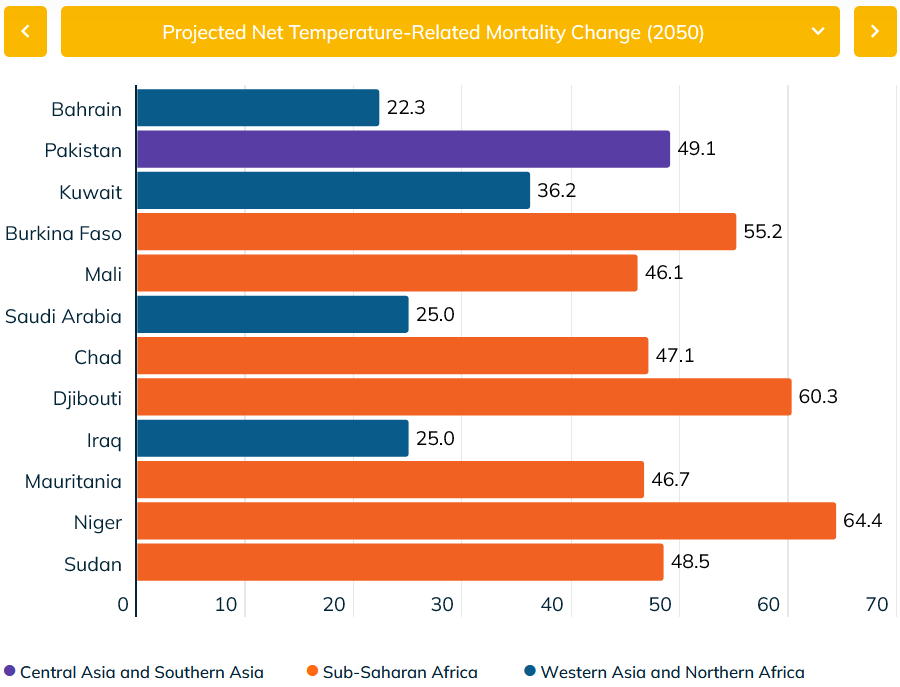
Chilling prospects 2026 warns that by 2050, 10 times more people in lower-income countries are projected to die from extreme temperatures than in higher-income countries. For instance, data from Climate Impact Lab projects supports that in countries across the Sahel, such as Burkina Faso and Niger, could see temperature-related mortality increases exceeding 60 deaths per 100,000 people by 2050 [2].
The analysis identifies 12 countries that are simultaneously among the top 20 highest current heat death rates and top 20 highest projected mortality increases by 2050 (see Figure below). These countries are currently facing severe heat mortality and anticipate the steepest projected increases. Mainly situated in Sub-Saharan Africa and the Middle East and North Africa, these 12 countries are: Bahrain, Burkina Faso, Chad, Djibouti, Iraq, Kuwait, Mali, Mauritania, Niger, Pakistan, Saudi Arabia, and Sudan [3].
Reducing heat mortality requires a multi-tiered approach, encompassing adapted heat action plans, early warning systems and healthcare infrastructure.
For more information, visit SEforALL's website.
Sources
[1] Romanello M, Walawender M, Hsu S-C, et al. The 2025 report of the Lancet Countdown on health and climate change: climate change action offers a lifeline. The Lancet. 2025. DOI: 10.1016/S0140-6736(25)01919-1
[2] Grover-Kopec E., Carleton T., & Greenstone M. (2026, March 25). Human health: Measuring the impact of rising temperatures on mortality to target adaptation planning. Climate Impact Lab. https://impactlab.org/research/human-health-measuring-the-impact-of-rising-temperatures-on-mortality-to-target-adaptation-planning
[3] https://www.seforall.org/chilling-prospects-special-edition-data-story/global-heat-mortality-data