
 Partager
Renewables power 26.7% of EU heating and cooling, thanks to biomass and heat pumps
According to Eurostat annual analysis, the share of renewable energy sources in heating and cooling in the EU has been increasing by 0.93 pp every year from 2021 to 2024.
Every year, Eurostat, the statistical office of the European Union, publishes data on the share of energy from renewables used for heating and cooling with a two-year offset (i.e. the data for the year 2024 is released in 2026).
The latest figures published by Eurostat show that 26.7% of total energy use for heating and cooling in the EU came from renewable sources in 2024, a 0.5 percentage point increase from 26.2% in 2023. At EU level, the annual average increased by 0.93 pp from 2021 to 2024, mostly due to the contribution of biomass and heat pumps.
Among the EU Member States, Sweden stood out with 67.8% of the energy used for heating and cooling in 2024 stemming from renewable sources followed by Finland (62.6%) and Latvia (61.8%). In contrast, in Ireland (7.9%), the Netherlands and Belgium (both 11.3%), renewable sources contributed the least to heating and cooling.
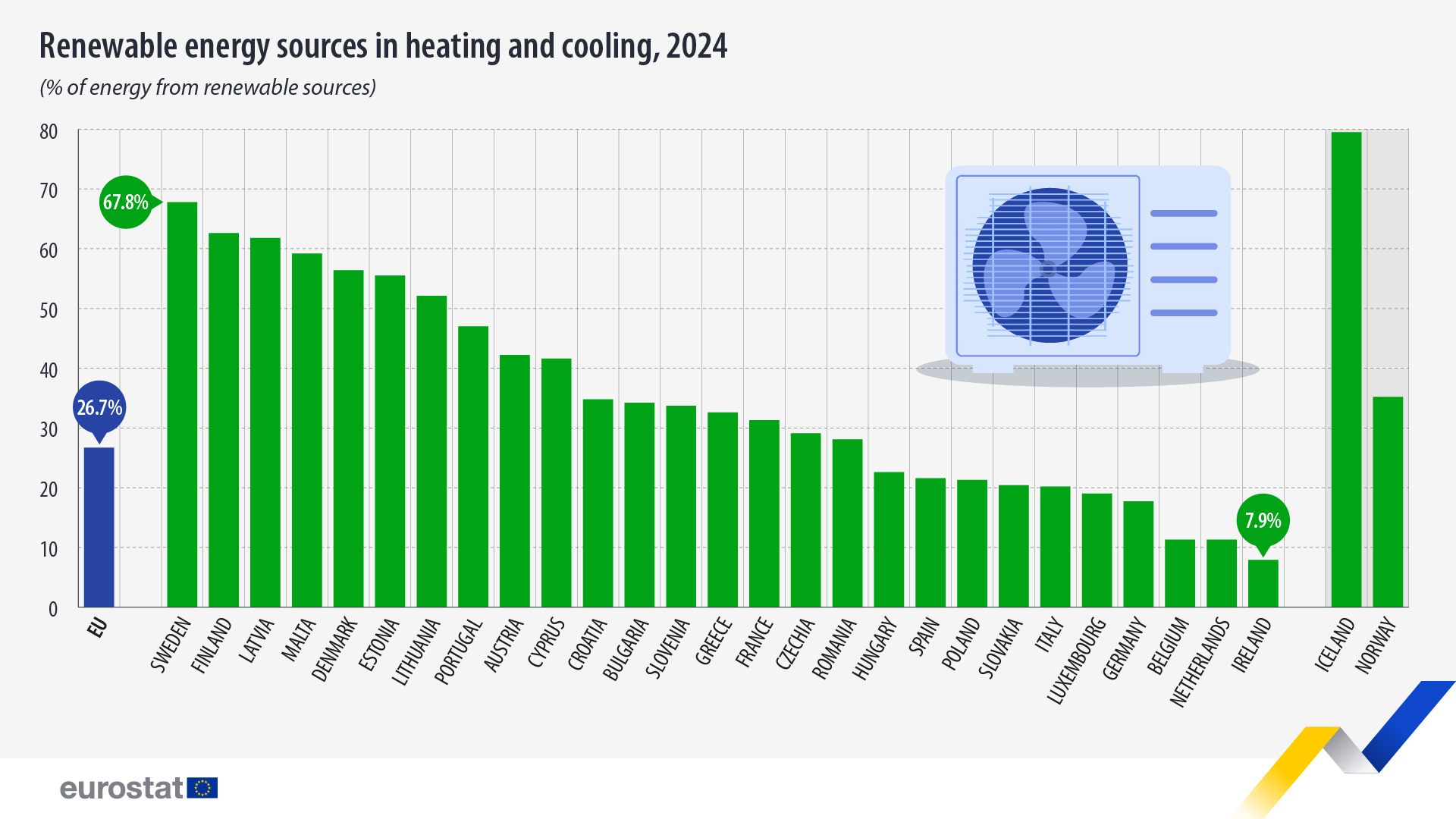
The EU Directive 2023/2413 of 18 October 2023 on the promotion of the use of energy from renewable sources requires EU countries to increase their annual average share of renewables in heating and cooling by at least 0.8% from 2021 to 2025 and by at least 1.1% from 2026 to 2030.
Compared with 2023, 16 EU Member States registered an increase in the share of renewable energy sources used in heating and cooling. Malta (+6.0 pp), Luxembourg (+3.7 pp) and Denmark (+1.9 pp) recorded the largest increases between 2023 and 2024.
Source
Eurostat. 26 January 2026. https://ec.europa.eu/eurostat/en/web/products-eurostat-news/w/ddn-20260126-1