
 Partager
 Document IIF
Étude numérique d’un transformateur de chaleur à absorption ammoniac-eau pour valoriser de la chaleur fatale industrielle à basse température face à l’augmentation de la température ambiante.
Numerical study of an ammonia/water absorption heat transformer to upgrade low-temperature industrial waste heat in regard to rising ambient temperature.
Numéro : 1108
Auteurs : COLLIGNON R., DEMASLES H., PHAN H. T.
Résumé
Multiple industries require heat at a high temperature while dissipating heat at moderate to low temperature. In this context, sorption systems are a promising solution able to valorise waste energy at a low electricity cost, up to ten times less electrical power compared to an equivalent vapor compression heat pump. Specifically, Absorption Heat Transformer (AHT) are a type of absorption machine able to recover lowlevel waste heat (~80°𝐶) in order to provide higher-level heat (> 100°𝐶). In this study, a single stage AHT based on the NH3/H2O mixture is developed. Results enable to evaluate the performances of the AHT fed by industrial waste heat and cooled by ambient air and show that the standard architecture is limited by summer operating conditions. The influence of both the waste heat and ambient air temperatures are evaluated and the effect of the inclusion of a compressor in the cycle is discussed.
Documents disponibles
Format PDF
Pages : 8 p.
Disponible
Prix public
20 €
Prix membre*
Gratuit
* meilleur tarif applicable selon le type d'adhésion (voir le détail des avantages des adhésions individuelles et collectives)
Détails
- Titre original : Numerical study of an ammonia/water absorption heat transformer to upgrade low-temperature industrial waste heat in regard to rising ambient temperature.
- Identifiant de la fiche : 30034168
- Langues : Anglais
- Sujet : Technologie
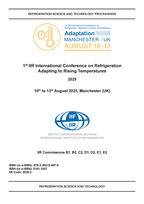
- Source : 1st IIR International Conference on Refrigeration Adapting to Rising Temperatures
- Date d'édition : 08/2025
- DOI : http://dx.doi.org/10.18462/iir.adaptation.2024.1108
Liens
Voir d'autres communications du même compte rendu (45)
Voir le compte rendu de la conférence
Indexation
-
High temperature absorption compression heat pu...
- Auteurs : REINHOLDT L., HORNTVEDT B., NORDTVEDT S. R., et al.
- Date : 21/08/2016
- Langues : Anglais
- Source : 12th IIR Gustav Lorentzen Conference on Natural Refrigerants (GL2016). Proceedings. Édimbourg, United Kingdom, August 21st-24th 2016.
- Formats : PDF
Voir la fiche
-
Design and Experimental Results of a Two-Stage ...
- Auteurs : MARINA A., SMEDING S. F., WEMMERS A. K., SPOELSTRA S., KREMERS P.
- Date : 31/08/2021
- Langues : Anglais
- Source : 13th IEA Heat Pump Conference 2021: Heat Pumps – Mission for the Green World. Conference proceedings [full papers]
- Formats : PDF
Voir la fiche
-
High temperature heat pumps for drying – first ...
- Auteurs : WILK V., HELMINGER F., LAUERMANN M., SPORR A., WINDHOLZ B.
- Date : 31/08/2021
- Langues : Français
- Source : 13th IEA Heat Pump Conference 2021: Heat Pumps – Mission for the Green World. Conference proceedings [full papers]
- Formats : PDF
Voir la fiche
-
Analysis of a steam generating high temperature...
- Auteurs : DUSEK S., LAUERMANN M., HELMINGER F., WILK V.
- Date : 31/08/2021
- Langues : Anglais
- Source : 13th IEA Heat Pump Conference 2021: Heat Pumps – Mission for the Green World. Conference proceedings [full papers]
- Formats : PDF
Voir la fiche
-
Modelling approach for a liquid-injected ammoni...
- Auteurs : AHRENS M., TONSBERG E., TOLSTOREBROV I., HAFNER A., EIKEVIK T.
- Date : 13/01/2021
- Langues : Anglais
- Source : 10th IIR Conference on Compressors and Refrigerants.
- Formats : PDF
Voir la fiche