
 Partager
Engineered atomic bonds help achieving improved cooling effect and durability in magnetic refrigeration
An international team of researchers led by the Technical University of Darmstadt, Germany, and the National Institute for Materials Science (NIMS), Japan, report a major advance in magnetocaloric materials, overcoming a long-standing durability problem. By redesigning atomic bonds inside a gadolinium-germanium compound, the scientists enhanced cooling performance while eliminating energy losses.
How does magnetocaloric refrigeration work?
The magnetocaloric effect is the physical phenomenon in which certain materials heat up when exposed to a magnetic field and cool down when the field is removed. When the spins of the dipoles constituting the material line up thanks to the application of the magnetic field, the material’s internal magnetic disorder decreases, decreasing its entropy and increasing its temperature. The opposite happens when the magnetic field is removed. This reversible temperature change can be harnessed for refrigeration:
1. Applying a magnetic field to the material heats it up;
2. A working fluid (such as water) is used to subtract heat from the magnetised hot material;
3. Removing the magnetic field causes a drop in temperature of the material below its starting point (because heat was removed from it in step 2);
4. The cold material can now absorb heat from the working fluid intended to be refrigerated.
The hysteresis issue
Unlike conventional vapor-compression systems, which rely on refrigerants and energy intensive compressors, magnetic refrigeration is a solid-state technology and has the potential to operate with far lower environmental impact and improved energy efficiency. However, bringing it to the market has been slowed down by the limited availability of high-performance magnetic refrigeration materials.
In addition, the sudden changes in both magnetic and crystal structure which happen in these materials when magnetised and demagnetised, referred to as first-order magnetic phase transition, often introduces hysteresis, an irreversible energy loss that reduces efficiency and causes materials to degrade over repeated cycles. Attempts to reduce hysteresis have typically weakened the cooling effect which can be obtained, forcing trade-offs between performance and durability.
A new approach to avoid hysteresis and boost performance
An international team of researchers led by the Technical University of Darmstadt, Germany, and the National Institute for Materials Science (NIMS), Japan, together with contributors from several Japanese institutions (Kyoto Institute of Technology, Japan Synchrotron Radiation Research Institute, University of Hyogo, Tohoku University) have proposed an innovative solution to avoid hysteresis issues.
In their study published in Advanced Materials [1], the scientists focused on a compound known as Gd5Ge4, a gadolinium-germanium material characterised by a large magnetocaloric response. In this material, the performance losses derive from changes in the length of covalent bonds between germanium atoms during magnetic transitions. These bond shifts cause a structural transformation and the associated hysteresis.
Through replacement of some germanium atoms with tin, the researchers created new Sn(Ge)₃-Sn(Ge)₃ bonds within the Gd5Ge4 compound that stabilize the transition, allowing the magnetic phase change to occur without hysteresis.
The result was a synergistic improvement: the reversible adiabatic temperature change doubled from 3.8 K to 8 K, while maintaining strong magnetic entropy change. The enhanced performance can be extended across a broad temperature range of 40-160 K (-233°C to -113°C), making the material particularly attractive for cryogenic applications such as hydrogen, nitrogen and natural gas liquefaction.
This innovative approach demonstrates that, by precisely engineering atomic bonding rather than simply adjusting bulk crystal properties, high performance and reversibility no longer need to be mutually exclusive in magnetic refrigeration. If successfully scaled, this strategy could accelerate the development of greener refrigeration systems and energy-efficient gas liquefaction technologies, key components in the transition toward a low-carbon energy future.
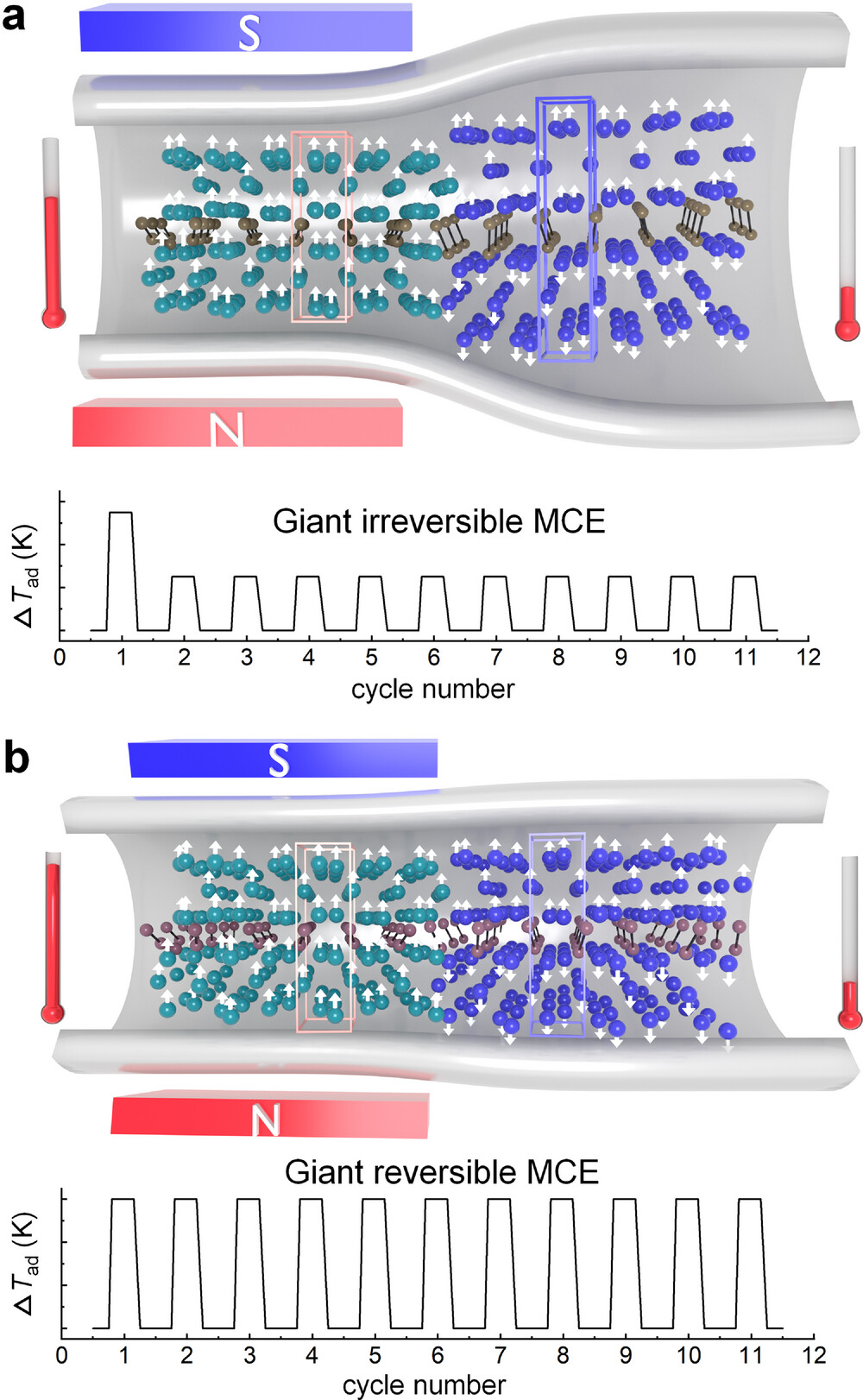
Different strategies to achieve a giant reversible magnetocaloric effect (MCE) [1]: a) limitation of first-order magnetic phase transition, but with limitations to MCE in repeated cycles due to hysteresis; b) covalent bond engineering, allowing repeated high MCE thanks to modification of covalent bonds within a unit cell.
For more information, the scientific paper is available in open access in Advanced Materials.
Source
[1] X. Tang, Y. Miura, N. Terada, et al. (2026). Control of Covalent Bond Enables Efficient Magnetic Cooling. Adv. Mater. 38, no. 7 (2026): e14295. https://doi.org/10.1002/adma.202514295