
 Partager
Experimental study assesses performance of a CO2 refrigeration unit developed for refrigerated transport
A new experimental study by researchers from the Italian National Research Council investigates the experimental performance of a laboratory prototype of a CO2 refrigeration unit developed for light and medium-sized refrigerated transport, comparing conventional and ejector-enhanced configurations.
A laboratory prototype of a CO2 refrigeration unit for refrigerated transport
A team of researchers from the Italian National Research Council (CNR), including Silvia Minetto, Antonio Rossetti and Francesco Fabris, respectively President, Secretary and member of IIR Commission D2 - Refrigerated Transport, recently published a study in the International Journal of Refrigeration [1] presenting the design and experimental assessment of a transcritical CO₂ (R-744) refrigeration unit developed for light and medium-sized refrigerated transport.
The work was carried out in the framework of the EU-funded ENOUGH project [2], in which the International Institute of Refrigeration (IIR) was also a consortium partner, and represents an intermediate step between previous numerical investigations and implementation of the technology on an actual refrigerated vehicle. A stationary prototype was installed and tested at the CNR Construction Technologies Institute (CNR-ITC) laboratories in Padova, Italy, allowing the researchers to characterise system performance under controlled conditions before final component selection and optimisation for vehicle installation.
The experimental campaign investigated refrigerated-space temperatures between −5°C and +5°C and ambient temperatures from 20°C to 40°C. Two operating configurations were assessed: a conventional back-pressure cycle and an ejector-enhanced cycle using a two-phase ejector.
Ejector enhances performance at higher ambient temperatures
The results demonstrate the potential of CO2 as working fluid for refrigerated transport applications while highlighting the crucial importance of system design to optimise performance according to operating conditions.
At lower ambient temperatures, the simpler back-pressure configuration achieved higher efficiency. However, as ambient temperature increases, the efficiency of a simple CO2 cycle can be significantly penalised due to the low CO2 critical temperature, which leads to high operating pressures and substantial expansion losses under transcritical conditions. Under high ambient temperature conditions, the inclusion of an ejector in the cycle becomes highly beneficial, as the experimental campaign demonstrated Coefficient of Performance (COP) improvements of up to approximately 25% compared with back-pressure operation.
The ejector configuration can also help maintain or increase cooling capacity as ambient temperature rises. According to the authors, this behaviour could be particularly valuable for transport applications, where the refrigeration demand typically increases under hotter outdoor conditions and therefore needs to be considered when designing and sizing mobile units.
The CO2 unit prototype also showed competitive energy performance when benchmarked against published results for systems using synthetic refrigerants, although the authors stress that such comparisons should be interpreted cautiously because of differences in system architectures, controls and operating conditions.
Following the laboratory investigations, an optimised and more compact version of the CO2 system is under implementation on a refrigerated vehicle, which has successfully obtained ATP certification and is ready for field testing. Future research will compare the performance of the final mobile system with that of the stationary laboratory prototype.
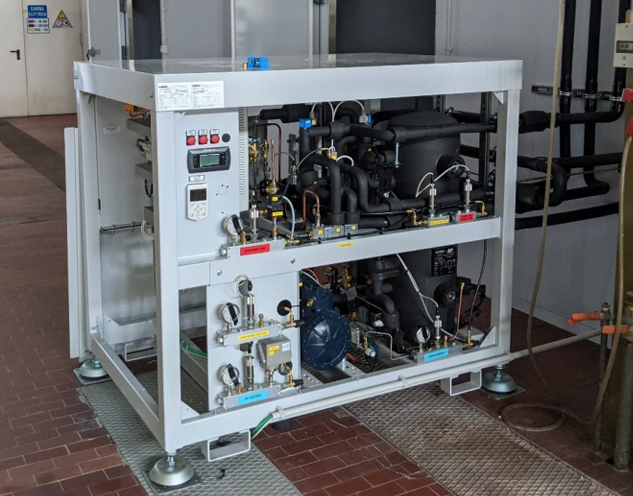
Figure. The CO2 refrigeration unit installed in CNR-ITC laboratories [1].
For more information, the scientific paper is available in open access in the International Journal of Refrigeration and in FRIDOC.
Sources:
[1] Shah, W., Fabris, F., Minetto, S., Marinetti, S., Rossetti, A. (2026). Experimental analysis of a R-744 refrigeration unit for light commercial vehicles. International Journal of Refrigeration 188 (2026) 106985. http://dx.doi.org/10.1016/j.ijrefrig.2026.106985
[2] ENOUGH Project. https://enough-emissions.eu/