
 Partager
Le Japon s’engage dans l’élaboration de politiques et d’outils numériques favorisant l’économie circulaire pour les frigorigènes
Un récent rapport du professeur Noboru Kagawa, représentant japonais à la Conférence générale de l’IIF et membre de la commission B1 de l’IIF, met en avant les mesures politiques, les systèmes de gestion numériques et les mécanismes de marché visant à améliorer la récupération et la régénération des frigorigènes au Japon.
Le séminaire intitulé « Vers la mise œuvre d’une économie circulaire des frigorigènes » (Toward the Realization of a Refrigerant Circular Economy) s’est tenu le 30 janvier 2026, dans le cadre du salon HVAC&R JAPAN 2026, qui a réuni 222 spécialistes et parties prenantes du secteur. Les débats qui y ont eu lieu ont souligné l’importance croissante de la gestion des frigorigènes pour atteindre les objectifs environnementaux et d’optimisation des ressources. Le Japon poursuit ses efforts pour résoudre les problématiques liées aux hydrofluorocarbures (HFC) non récupérés, aux fuites de frigorigènes pour les unités en fonctionnement et à la nécessité de garantir l’approvisionnement à long terme en frigorigènes, dans le cadre de leur réduction progressive en vertu de l’Amendement de Kigali. Les présentations des agences gouvernementales, des autorités locales, des organisations industrielles et des chercheurs ont mis en avant l’importance d’améliorer les taux de récupération, d’étendre l’utilisation des frigorigènes régénérés et d’intégrer la gestion des frigorigènes dans des stratégies de décarbonation plus globales.
Plusieurs projets présentés lors du séminaire étaient axés sur l’utilisation d’outils numériques et d’une gestion fondée sur les données. Parmi celles-ci figuraient le système de gestion des frigorigènes (RaMS) et son extension numérique RaMS-ex, qui améliorent la traçabilité des opérations de chargement, de récupération, de régénération et d’élimination des frigorigènes. La préfecture de Tokyo a aussi fait état du déploiement de systèmes de surveillance basés sur l’Internet des objets (IoT) pour détecter les fuites de frigorigènes, ainsi que de la mise en place d’un dispositif de certification technique destiné aux opérateurs responsables de la charge et de la récupération des frigorigènes. Ces mesures visent à accroître la conformité, la transparence des données et les performances techniques tout au long de la chaîne de valeur des frigorigènes.
Concevoir un système circulaire de gestion des frigorigènes
Dans son rapport publié dans JARN (Japan Air Conditioning, Heating & Refrigeration News) [1], le professeur Noboru Kagawa, délégué japonais à la Conférence générale de l’IIF et membre de la commission B1 de l’IIF, a présenté les grandes lignes d’un cadre pour une économie circulaire des frigorigènes combinant des instruments politiques, des incitations économiques et une infrastructure numérique. La méthode proposée comprend des crédits de frigorigènes pour soutenir les opérations de récupération et de régénération, des mécanismes d’incitation liés à la performance environnementale, ainsi qu’une gestion intégrée des données. Ensemble, ces éléments constituent un modèle de gestion circulaire visant à améliorer la traçabilité des frigorigènes et à accroître leur récupération et leur réutilisation, notamment pour les HFC.
Le rapport souligne l’importance d’une collaboration entre les autorités de régulation, les industriels, les propriétaires d’équipement et les prestataires de services pour assurer une circularité efficace des frigorigènes. Les frigorigènes régénérés devraient prendre une place croissante pour compenser les pénuries de HFC tout en réduisant les émissions de gaz à effet de serre (GES). Outre le Japon, le rapport identifie également des opportunités de transfert d’expertise et d’approches de conception de systèmes vers d’autres régions, en particulier l’Asie du Sud-Est, où l’amélioration de la récupération et de la régénération des frigorigènes pourrait contribuer à la fois aux objectifs d’atténuation des effets du changement climatique et de sécurité des ressources.
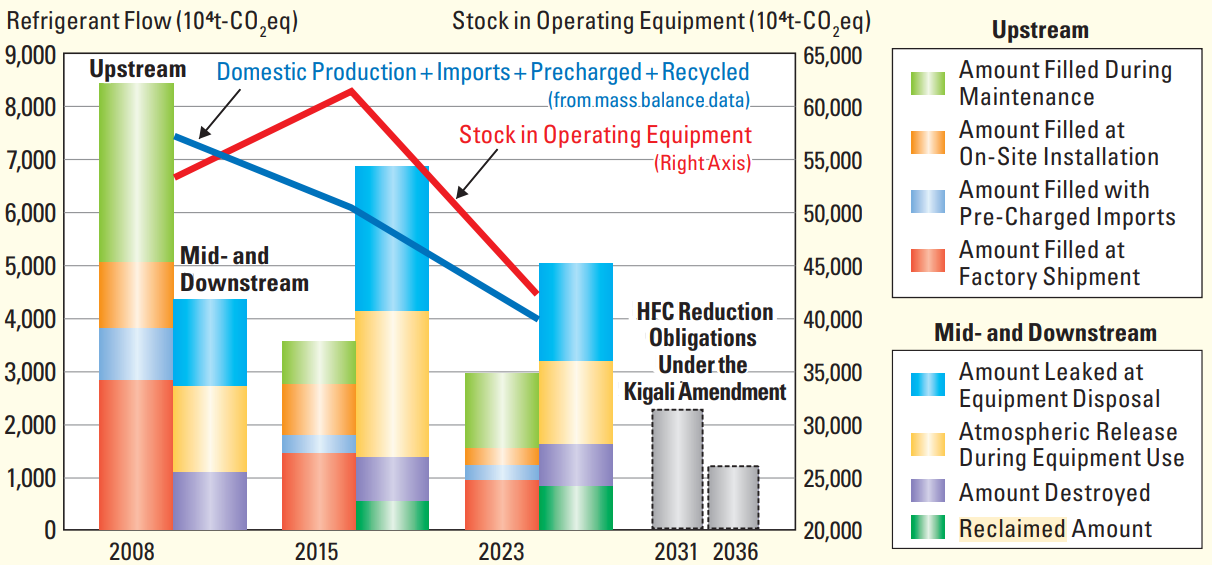
Figure 1. Débits massiques des fluorocarbures (CFC, HCFC, HFC) au Japon et objectifs de l’Amendement de Kigali (crédits image : Noboru Kagawa)
|
Anglais |
Français |
|---|---|
| Refrigerant Flow | Débit des frigorigènes |
| Stock in Operating Equipment | Stocks dans les équipements en fonctionnement |
| Domestic Production + Imports + Precharged + Recycled (from mass balance data) | Production nationale + importations + préchargés + recyclés (selon les données du bilan massique) |
| Stock in Operating Equipment (Right Axis) | Stocks dans les équipements en fonctionnement (axe de droite) |
| Upstream | En amont |
| Mid- and Downstream | Au milieu et en aval |
| HFC Reduction Obligations Under the Kigali Amendment | Obligations de réduction des HFC en vertu de l’Amendement de Kigali |
| Amount Filled During Maintenance | Quantité réinjectée à la maintenance |
| Amount Filled at On-Site Installation | Quantité réinjectée à l’installation sur site |
| Amount Filled with Pre-Charged Imports | Quantité réinjectée à partir d’importations préchargées |
| Amount Filled at Factory Shipment | Quantité réinjectée à l’expédition en usine |
| Amount Leaked at Equipment Disposal | Quantité perdue lors de la mise au rebut des équipements |
| Atmospheric Release During Equipment Use | Rejets dans l’atmosphère pendant l’utilisation des équipements |
| Amount Destroyed | Quantité détruite |
| Reclaimed Amount | Quantité récupérée |
Pour en savoir plus, consulter le rapport disponible sur le site web du JARN.
Sources :
[1] Designing a Refrigerant Circular Economy – Policy, Technology, and Market Perspectives. https://www.ejarn.com/article/detail/93551