
 Partager
Les technologies de refroidissement piézoélectriques offrent de nouvelles solutions de régulation thermique pour les appareils électroniques compacts
À mesure que les appareils électroniques deviennent plus compacts et puissants, le défi lié à la dissipation de la chaleur devient un enjeu majeur. Une étude récemment publiée dans la Revue internationale du froid étudie la manière dont les technologies de refroidissement à effet piézoélectrique inverse pourraient constituer des alternatives compactes, écoénergétiques et fiables aux systèmes de régulation thermique conventionnels.
Problématiques de refroidissement dans des appareils électroniques toujours plus compactes
La hausse des densités de puissance dans les appareils électroniques, attribuable à leur miniaturisation croissante, s’est accompagnée d’une production accrue de la chaleur dans les composants également toujours plus compacts. Une régulation thermique efficace est par conséquent nécessaire pour préserver leur performance, leur fiabilité ainsi que leur durée de vie. En l’absence d’un refroidissement adéquat, la surchauffe peut dégrader les composants électroniques, réduire leur efficacité et écourter leur durée d’exploitation.
Une récente étude de synthèse [1], publiée dans la Revue internationale du froid par des chercheurs de l’Université El Manar de Tunis (Tunisie), de l’Université de Gabès (Tunisie) et de l’Université islamique Imam Mohammad Ibn Saud (Arabie saoudite), examine le potentiel des technologies de refroidissement fondées sur l’effet piézoélectrique inverse comme alternative aux solutions conventionnelles de régulation thermique. L’effet piézoélectrique décrit la capacité de certains matériaux à générer une charge électrique lorsqu’ils sont soumis à une contrainte mécanique. Son pendant, l’effet piézoélectrique inverse, fonctionne dans le sens inverse : lorsqu’un champ électrique est appliqué, le matériau subit une déformation mécanique.
Cette propriété permet aux matériaux piézoélectriques de convertir des signaux électriques en vibrations ou mouvements contrôlés. Dans les applications de refroidissement, ces vibrations peuvent générer un flux d’air, pomper des fluides ou améliorer le transfert de chaleur à proximité des composants électroniques. Étant donné que ces systèmes reposent sur des éléments oscillants plutôt que sur des pièces mécaniques rotatives, ils peuvent fonctionner en silence, consommer très peu d’énergie et être intégrés dans des appareils pour espace réduit et sensibles au bruit, tels que les ordinateurs portables, les tablettes et les appareils électroniques portables.
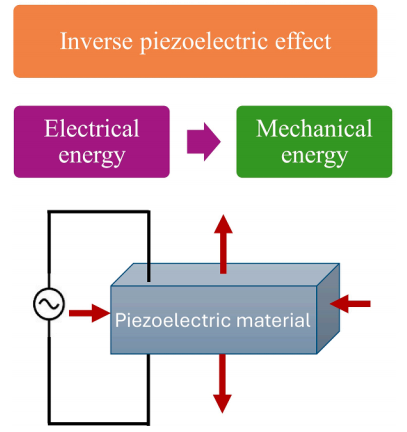
Figure 1. Schéma de l’effet piézoélectrique inverse [1].
| Anglais | Français |
|---|---|
| Inverse piezoelectric effect | Effet piézoélectrique inverse |
| Electrical energy | Énergie électrique |
| Mechanical energy | Énergie mécanique |
| Piezoelectric materiel | Matériau piézoélectrique |
Technologies de refroidissement piézoélectriques abordées dans cette étude
L’article analyse plusieurs types de technologies de refroidissement qui exploitent l’effet piézoélectrique inverse pour améliorer la dissipation thermique dans les appareils électroniques :
- Ventilateurs piézoélectriques (PF) : Ces dispositifs génèrent un flux d’air à l’aide d’une poutre ou d’une pale vibrante actionnée par actionnement piézoélectrique, plutôt que par des pales rotatives comme dans les ventilateurs classiques. Les oscillations perturbent la couche limite thermique autour des composants électroniques, améliorant ainsi le transfert de chaleur par convection. Grâce à leur compacité, leur fonctionnement silencieux et leur faible consommation énergétique, les ventilateurs piézoélectriques sont particulièrement adaptés au refroidissement localisé à proximité de composants, tels que les processeurs, les modules de mémoire ou les dispositifs d’alimentation.
- Micropompes piézoélectriques (PMP) : Les micropompes emploient la déformation de matériaux piézoélectriques pour propulser du liquide ou du gaz en faible quantité à travers les microcanaux. Lorsqu’une tension est appliquée, un diaphragme à l’intérieur du dispositif se déplace, créant des écarts de pression qui poussent le fluide à travers le système. Ces pompes sont adaptées au refroidissement liquide dans les appareils électroniques compacts où il est nécessaire de disposer d’un contrôle précis du débit et une dissipation localisée de la chaleur.
- Microventilateurs piézoélectriques (PMB) : Les microventilateurs produisent un flux d’air pulsé grâce à un actionnement piézoélectrique, sans aucune pièce mécanique rotative. Conçus principalement pour déplacer de l’air plutôt que des liquides, ils sont particulièrement utiles pour le refroidissement ciblé à l’intérieur des enveloppes électroniques compactes. Leur fonctionnement à haute fréquence, leur fiabilité mécanique et leur fonctionnement silencieux en font des solutions intéressantes pour des applications, telles que la microélectronique, l’avionique et les technologies portatives.
- Jets synthétiques piézoélectriques (PSJ) : Les jets synthétiques s’appuient sur un diaphragme vibrant à l’intérieur d’une cavité scellée pour aspirer et expulser alternativement de l’air à travers un orifice, produisant ainsi des jets pulsés à haute fréquence. Ces jets perturbent les couches limites thermiques et améliorent le transfert de chaleur par convection sans nécessiter de sources d’air externes, ce qui les rend adaptés aux systèmes électroniques scellés ou soumis à des contraintes d’espace.
- Agitateurs piézoélectriques translationnels (PTA) : Ces dispositifs produisent un mouvement oscillatoire linéaire qui induit un mouvement d’air localisé et un mélange à proximité des surfaces chauffées. En perturbant les couches d’air stagnant autour des points chauds, les agitateurs translationnels améliorent le transfert de chaleur dans les espaces étroits où les mécanismes traditionnels de circulation d’air sont difficiles à déployer.
Défis et perspectives du refroidissement piézoélectrique
Malgré leurs avantages, les technologies de refroidissement piézoélectrique sont majoritairement au stade de la recherche et du développement. L’un des principaux défis mis en évidence dans cet article de synthèse est l’absence d’indicateurs de performance normalisés. Il est donc difficile d’établir une comparaison entre les différents dispositifs et les diverses approches employées dans les études publiées sur le refroidissement.
Leur intégration dans des systèmes électroniques existants reste également complexe. Bien que de nombreux prototypes affichent des performances satisfaisantes en laboratoire, l’intégration de ces technologies dans des boîtiers électroniques compacts ou dans des systèmes plus vastes doit encore passer par une optimisation de la conception, de l’adaptabilité et des procédés de fabrication.
Les recherches ultérieures devront également se concentrer sur l’amélioration des stratégies de commande. Des systèmes de contrôle avancés, qui reposent éventuellement sur une rétroaction en temps réel sur la température ou les algorithmes IA, pourraient ajuster de manière dynamique les conditions de fonctionnement des dispositifs piézoélectriques afin d’en optimiser les performances de refroidissement et l’efficacité énergétique.
La durabilité des matériaux est un autre aspect important. De nombreux dispositifs piézoélectriques actuels reposent sur des céramiques à base de plomb, telles que le titanate-zirconate de plomb, ce qui soulève des préoccupations environnementales et réglementaires. La conception d’alternatives efficaces sans plomb et de méthodes de fabrication évolutives sera donc primordiale pour une adoption à grande échelle.
Dans l’ensemble, cette étude suggère qu’en innovant dans les matériaux, l’intégration des systèmes et l’évaluation des performances, les technologies de refroidissement piézoélectriques peuvent jouer un rôle essentiel dans la régulation thermique des appareils électroniques de nouvelle génération, en particulier dans les applications où la compacité, un faible niveau sonore et l’efficacité énergétique sont importants.
Consulter l’article de synthèse dans la Revue internationale du froid et sur FRIDOC.
Source
[1] Mehrez, Z., Elfalleh, W. (2025). Synthèse approfondie de la gestion thermique dans les systèmes électroniques utilisant l’effet piézoélectrique inverse. Revue internationale du froid, 179, 321-341. https://doi.org/10.1016/j.ijrefrig.2025.08.010