
 Partager
Viet Nam National Cooling Action Plan targets 97% reduction in refrigeration emissions by 2045
Launched in December 2025, the Viet Nam’s first National Cooling Action Plan targets improvements in appliance efficiency, refrigerant lifecycle management, passive and urban cooling strategies, and cold chain development, with implementation phased between 2024 and 2045. Full implementation of combined measures could deliver more than 800 terawatt-hours of electricity savings and reduce emissions by 97%.
Viet Nam has integrated refrigeration into its national climate and energy policies, and its 2022 Nationally Determined Contribution (NDC) outlines key mitigation measures related to air conditioning, refrigeration, and refrigerants [1].
Viet Nam‘s refrigeration sector emissions
Between 2018 and 2022, Viet Nam’s refrigeration sector expanded at an average of 2.3% a year, led by the residential and commercial air conditioning sub-sector, which grew by 7.6% annually, reaching over 5.9 million units imported and manufactured [2]. As illustrated on Figure 1, the refrigeration sector generated 64.68 MtCO2e in 2022, accounting for about 14% of the country’s projected total emissions.
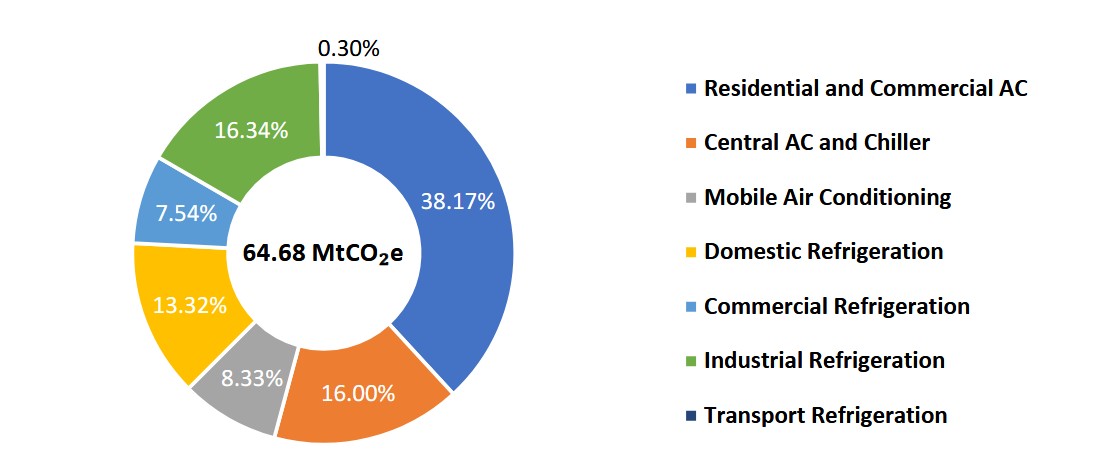
Figure 1. Total business-as-usual GHG emissions from the refrigeration sector and contribution by sub-sectors in 2022 [2].
Under a business-as-usual scenario, electricity demand from the refrigeration sector could triple from 65.95 TWh in 2022 to about 200 TWh in 2050, while emissions could double from the 2022 levels, peaking at 116 million tonnes of CO2e in 2045.
Viet Nam’s National Cooling Action Plan: objectives and framework
Launched in December 2025, Viet Nam’s National Cooling Action Plan is centred around a strict adherence to the legally binding phasedown schedules for HCFCs and HFCs [2]. The plan aims to reduce refrigeration-sector emissions and electricity demand through improvements in appliance energy efficiency, refrigerant lifecycle management, passive and urban cooling strategies, and cold chain development, with implementation phased between 2024 and 2045.
Full implementation of combined measures could deliver more than 800 terawatt-hours of electricity savings and reduce emissions by 97% [3].
The proposed roadmap includes the following initiatives:
1. Refrigerant transition
- Complete phase out HCFCs by 2040
- 80% reduction in HFC consumption by 2045 (aligned with the Kigali Amendment)
- Transition to natural or ultra-low-GWP refrigerants in all new refrigeration equipment beyond 2045
- Launch refrigerant recovery and reclaim centres
- Workforce capacity building: at least 8,000 technicians certified in the safe handling of A2L/A3 refrigerants by 2034, cutting leakage rates and accident risks
2. Energy-efficient appliances
- Strengthen minimum energy performance standards (MEPS) for air conditioners, chillers and refrigerators
- Launch public awareness campaigns on efficient thermostat settings
3. Passive and urban cooling strategies
- Promote passive cooling measures (cool-roof programmes, better insulation, shading, ventilation)
- Encourage urban heat reduction strategies such as green spaces and reflective materials
4. Sustainable Cold Chain
- Implement sustainable refrigeration practices within the agriculture and seafood industries
- Decarbonise refrigerated transport and transition to low-GWP equipment in cold chain logistics and supermarket sector
For more information, Viet Nam’s National Cooling Action Plan is available on FRIDOC.
Sources
[1] Viet Nam’s updated Nationally Determined Contributions (NDC). (2022). https://unfccc.int/sites/default/files/NDC/2022-11/Viet%20Nam_NDC_2022_Eng.pdf
[2] National Cooling Action Plan. Developing the National Cooling Programme in Viet Nam. Final Report. JULY 2025 https://www.energytransitionpartnership.org/wp-content/uploads/2025/08/20250729_Final_National-Cooling-Action-Plan_rev_clean_EN.pdf
[3] https://vir.com.vn/national-cooling-plan-to-support-vietnams-net-zero-goals-141933.html