
 Partager
World Energy Outlook 2026: global cooling demand surpasses heating demand
In the 2026 edition of its flagship report, the IEA projects that cooling demand will surpass heating demand globally by 2035, underscoring the importance of stringent minimum energy performance standards to curb energy consumption in the residential sector.
In November 2026, the International Energy Agency (IEA) released its annual World Energy Outlook report, which analyses global trends in energy demand and supply.
Cooling demand exceeds heating demand worldwide
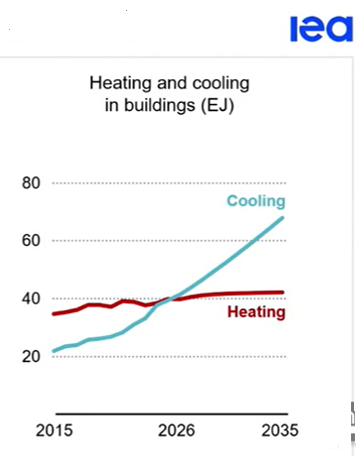
in buildings [2]
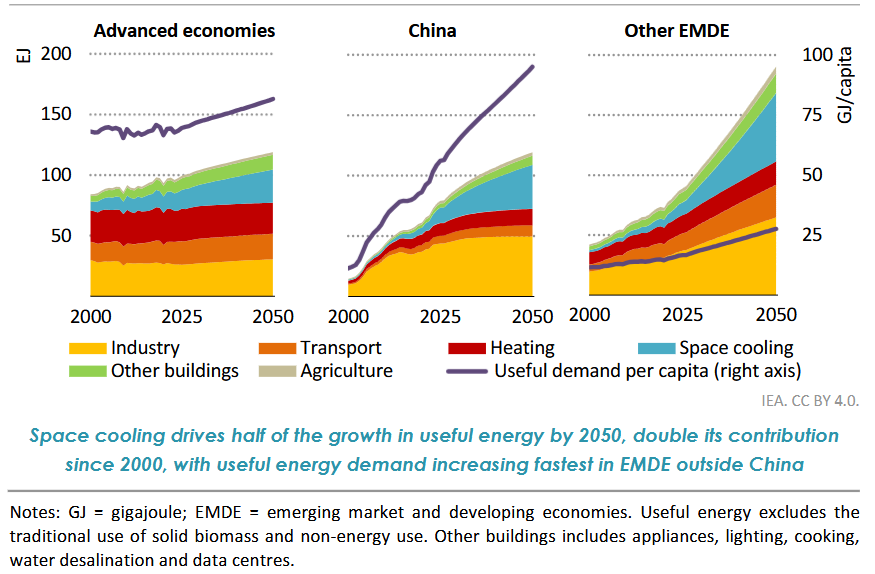
Across all modelled scenarios, cooling is expected to account for over 40% of the growth in energy demand by 2035 [1], both in tropical regions and in areas where rising temperatures, more frequent heatwaves, and increasingly warm summers are driving greater demand for air conditioning, particularly in Europe.
One of the key findings of this year’s report is that for the first time in energy history, global cooling needs are overtaking heating demand (see figure 1).
In emerging markets and developing economies outside China, demand for air conditioning is expected to skyrocket. With 85% of households exposed to high temperatures, air conditioner ownership should rise from 20% today, to 32% by 2035 and 45% by 2050 in all modelled scenarios.
The IEA anticipates that there will be more cooled floorspace than heated floorspace across the world by mid-century (see figure 2).
Energy efficiency reduces energy demand in the residential sector
Energy demand and CO2 emissions associated with air conditioning could be curbed through the widespread adoption of stringent minimum energy performance standards (MEPS) [3].
The 2026 World Energy Outlook confirms that in the residential sector, energy efficiency represents an asset towards energy security. Efficiency gains made in lighting, televisions, refrigeration and other white goods over the past decade, were estimated at 600 TWh, which is greater than the world’s annual consumption of electricity for data centres.
The IEA projects that aligning MEPS in all countries with the most stringent standards in force today would unlock an additional 800 TWh of savings by 2035.
Renewable energy and access to electricity
The current global energy crisis has strengthened the strategic role of electrification. Since 2019, electricity demand has grown by 3.3% per year, driven by electricity-intensive sectors such as advanced manufacturing and AI, strong growth in the sales of electric equipment such as air conditioners, and the increasing deployment of electrification technologies like electric vehicles and heat pumps.
The IEA further noted that for the first time on record, a renewable source of energy, solar photovoltaics, contributed not only the largest share of the increase in global power generation in 2025 but also a larger share of the growth in overall energy demand than any other source.
Expanding access to affordable electricity is a key component of successful electrification. The IEA modelled that the global electrification rate (the share of electricity in final energy consumption) currently estimated at 23% in 2025, could reach 35% by 2035 in a Net Zero Emissions scenario [a] (see Figure 3).
These findings support the implementation of the COP31 Global Climate Action Agenda Electrification Delivery Package. Bringing together 150 countries, along with 37 cities and about 260 businesses, the COP31 Electrification Delivery Package aims to mobilise approximately 156 USD billions in clean energy investment, expand access to electricity, and accelerate the electrification of power grids, transport, buildings, and industry [4].
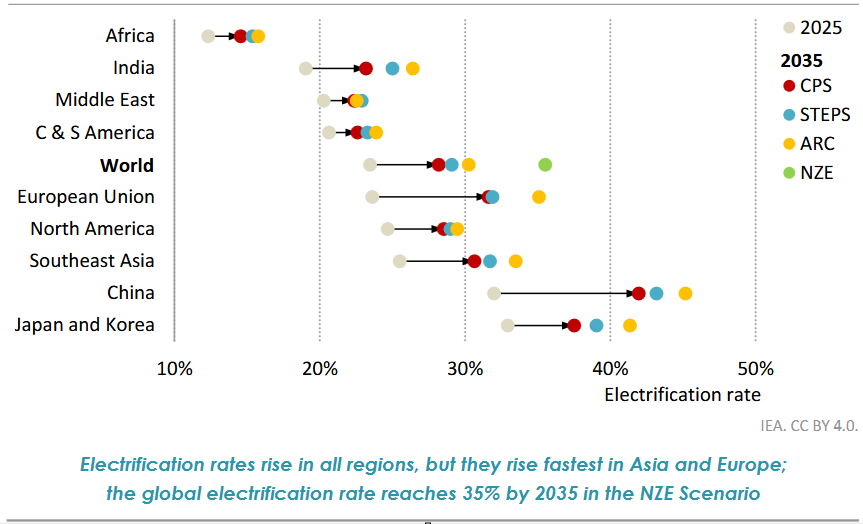
[a] The IEA Net Zero Emissions by 2050 (NZE) Scenario is designed to achieve an ambitious reduction in energy-related emissions. It maps out a way for the global energy system to achieve net zero CO2 emissions by 2050 and is consistent with a long-term goal of limiting the rise in global average temperatures to 1.5°C (with a 50% probability). The NZE considers a global energy sector pathway built on four pillars: low-emissions power generation; efficiency improvements and electrification of end-uses; low-emissions fuels; and carbon dioxide capture and storage.
For more information, especially regional insights, the complete report is available on FRIDOC or on the IEA website.
Sources
[1] IEA (2026), World Energy Outlook 2026, IEA, Paris https://www.iea.org/reports/world-energy-outlook-2026 , Licence: CC BY 4.0 (report); CC BY NC SA 4.0 (Annex A)
[2] IEA (2026), World Energy Outlook 2026 report launch. https://www.iea.org/events/world-energy-outlook-2026
[3] Baha M., Hammami S., Dupont J-L. (2025). The role of refrigeration in global economy. 3rd edition. 60th Technical Brief on Refrigeration Technologies. International Institute of Refrigeration (IIR), Paris. http://dx.doi.org/10.18462/iir.TechBrief.04.2025
[4] UNFCCC. 23 November 2026. https://unfccc.int/news/cop31-delivers-important-progress-across-negotiations-and-action-agenda-advancing-implementation-but