
 Partager
L’IA devrait faire doubler la demande d’électricité des centres de données (en anglais)
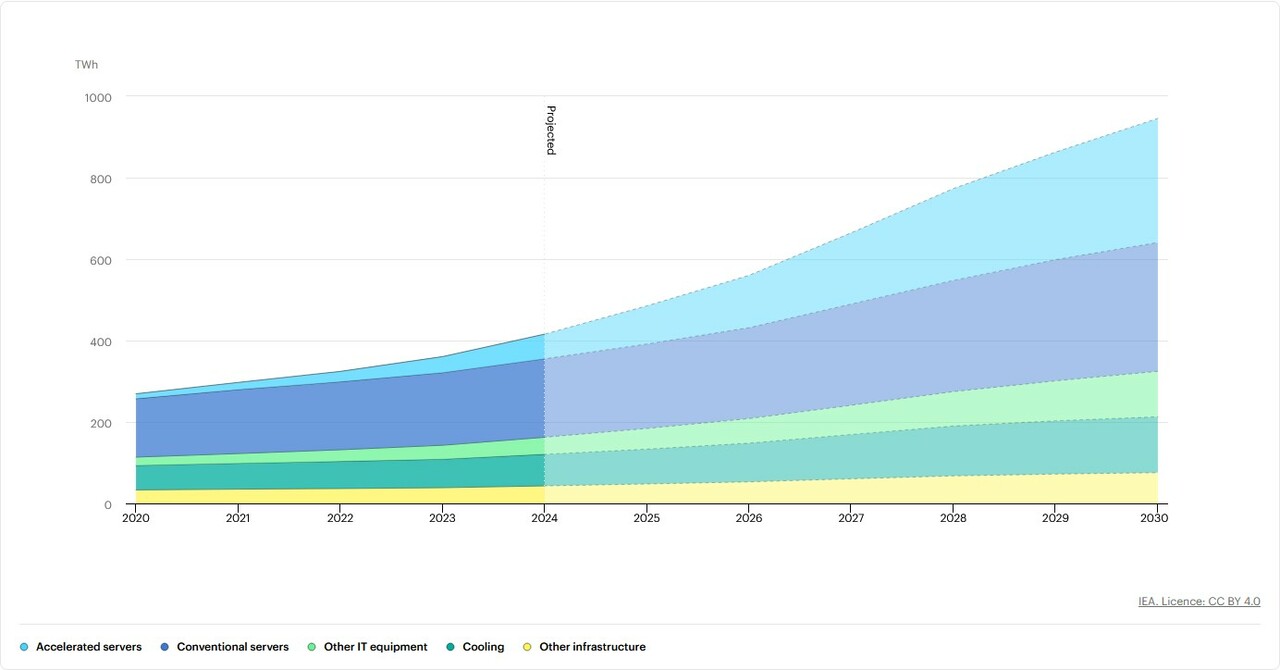
Dans un rapport spécial, l’AIE prévoit que la consommation électrique des centres de données atteindra environ 945 TWh d’ici 2030, soit plus du double du niveau actuel, principalement en raison de l’utilisation de l’IA.
In April 2025, the International Energy Agency (IEA) released a special report analysing the impact of Artificial intelligence (AI) on global electricity consumption.
According to IEA, electricity demand from data centres worldwide is set to more than double by 2030 to around 945 terawatt-hours (TWh) [1]. AI will be the most significant driver of this increase, with electricity demand from AI-optimised data centres projected to more than quadruple by 2030. The United States accounts for the largest share of this projected increase by far, followed by China.
Perhaps the biggest hidden cost of AI isn't just the computing power—it's the energy needed to keep those supercharged servers from overheating. According to IIR, 30% to 55% of energy consumption in data centres is used for cooling [2]. Emerging cooling technologies, such as liquid cooling, could potentially halve the sector’s energy consumption. In addition, liquid-cooled data centres offer a higher potential for waste heat recovery due to their higher temperatures of waste heat [3]. Reusing waste heat from data centres presents a promising opportunity to reduce costs and increase efficiency.
Indeed, cooling efficiency is expected to continue to improve by 2030, supported by advancements in cooling technologies and data centre operational management. Figure 1 features the part of cooling, among other equipment, in global data centre electricity consumption.
According to IEA, the global weighted average the Power Usage Effectiveness (PUE) is projected to improve, decreasing from 1.41 to 1.29 on average. The decrease in PUE would save around 90 TWh of electricity demand. This represents around a 30% reduction in cooling requirements per unit of IT electricity used.
- A PUE of 1.0 indicates perfect energy efficiency, where all the energy used is consumed by the IT equipment, and none is wasted on supporting infrastructure such as cooling, lighting, or power distribution.
- Typical PUE values for modern data centers are generally between 1.1 and 1.8, where values closer to 1 are considered better, indicating that less energy is wasted in cooling
In simple terms, the lower the PUE, the more energy-efficient the data center is. Reducing PUE is a primary goal for data center operators aiming to improve sustainability and reduce operational costs.
Emerging technologies like waste heat recycling could further offset energy demands. Some data centers are already experimenting with redirecting excess heat to warm nearby buildings or even power district heating systems—a measure that could turn a major inefficiency into a valuable resource.
The Road Ahead
While AI's energy demands are daunting, they're not insurmountable. Advances in cooling technology, renewable energy integration, and more efficient chip designs could help mitigate the strain on global power grids. But without proactive measures, the AI revolution risks colliding with another pressing challenge: the world's accelerating energy needs.
For policymakers and tech companies alike, the message is clear: The future of AI depends not just on smarter algorithms, but on smarter energy solutions.
For more information, the complete report is available on the IEA website.
Sources
[1] IEA (2025), Energy and AI, IEA, Paris https://www.iea.org/reports/energy-and-ai , Licence: CC BY 4.0
[2] Baha M., Hammami S., Dupont J-L. The role of refrigeration in global economy. 3rd edition. 60th Technical Brief on Refrigeration Technologies. International Institute of Refrigeration (IIR), Paris. http://dx.doi.org/10.18462/iir.TechBrief.04.2025
[3] Shao, S., Zhang, P., & Li, X. (2025). Cooling technologies for sustainable data centres. 59th IIR Technical Brief on Refrigeration Technologies. International Institute of Refrigeration (IIR). https://doi.org/10.18462/iir.TechBrief.01.2025