
 Partager
 Document IIF
Atténuation des émissions de gaz à effet de serre issus des systèmes frigorifiques commerciaux : quels sont les aspects importants ?
Mitigation of greenhouse gas emissions from commercial refrigeration systems: what matters?
Auteurs : NEKSÅ P., LUNDQVIST P.
Résumé
Mitigation of greenhouse gas emissions from the refrigeration, air conditioning and heat pump sector is a challenge that has to be addressed. In order to understand the possibilities it is useful to divide the emissions into two categories: direct, caused by release of refrigerants into the atmosphere, and indirect, caused by the release of CO2 in power production plants. The most important sectors are commercial refrigeration and mobile air conditioning which together represent about 70% of the total direct greenhouse gas emissions from the refrigeration, A/C and heat pump sector. This presentation concentrates on the discussion to the commercial refrigeration sector. The emission situation and possible alternatives for emission mitigation and their cost are discussed. The relation between the direct and indirect effect varies considerably with factors such as refrigerant choice and charge, leakage rates and the regional power mix. The geographical situation of the country in question is also important. It is therefore difficult to generalize the characteristics of a certain application, for example a supermarket.
Documents disponibles
Format PDF
Pages : 2005-3
Disponible
Prix public
20 €
Prix membre*
Gratuit
* meilleur tarif applicable selon le type d'adhésion (voir le détail des avantages des adhésions individuelles et collectives)
Détails
- Titre original : Mitigation of greenhouse gas emissions from commercial refrigeration systems: what matters?
- Identifiant de la fiche : 2006-0998
- Langues : Anglais
- Sujet : Environnement, Généralités
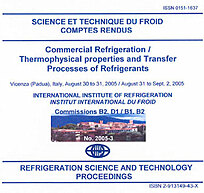
- Source : Commercial Refrigeration. Thermophysical Properties and Transfer Processes of Refrigerants. Proceedings of the IIR International Conferences.
- Date d'édition : 30/08/2005
Liens
Voir d'autres communications du même compte rendu (140)
Voir le compte rendu de la conférence
Indexation
-
French plan of reduction of greenhouse gas emis...
- Auteurs : DECOUVELAERE P., HEYNDRICKX F., CLODIC D.
- Date : 17/08/2003
- Langues : Anglais
- Source : 21st IIR International Congress of Refrigeration: Serving the Needs of Mankind.
- Formats : PDF
Voir la fiche
-
Quantification of refrigerant banks and emissio...
- Auteurs : CLODIC D., BARRAULT S., PALANDRE L., et al.
- Date : 30/08/2005
- Langues : Anglais
- Source : Commercial Refrigeration. Thermophysical Properties and Transfer Processes of Refrigerants. Proceedings of the IIR International Conferences.
- Formats : PDF
Voir la fiche
-
Réparer la planète : la révolution de l'économi...
- Auteurs : ROUER M.
- Date : 03/04/2008
- Langues : Français
Voir la fiche
-
Building services for low carbon supermarkets.
- Auteurs : CAMPBELL A., RILEY O.
- Date : 2010
- Langues : Anglais
- Source : Annual proceedings of the Institute of Refrigeration. 2009-2010.
Voir la fiche
-
Commercial refrigeration: on the way to sustain...
- Auteurs : KRUSE H.
- Date : 01/2006
- Langues : Anglais
- Source : Commercial Refrigeration. Thermophysical Properties and Transfer Processes of Refrigerants. Proceedings of the IIR International Conferences.
- Formats : PDF
Voir la fiche