
 Partager
Une récente publication du projet ENOUGH sur les émissions de GES dans le secteur alimentaire propose une comparaison objective entre différents pays de l’UE, filières et catégories d’émissions
Une équipe de chercheurs du consortium ENOUGH (London South Bank University, Royaume-Uni ; Institut des technologies de construction du Conseil national italien de la recherche (CNR), Italie ; SINTEF Ocean, Norvège ; INRAE, France ; IIF) a récemment publié une méthodologie détaillée fondée sur une approche descendante ainsi qu’un jeu de données permettant d’identifier les émissions de GES de la chaîne des produits alimentaires (hors alimentation animale) pour dix pays européens.
La principale mission du projet est de soutenir la stratégie durable de l’UE de la ferme à l’assiette en fournissant des outils et des solutions techniques, financiers et politiques pour réduire les émissions de GES et atteindre la neutralité climatique dans l’industrie alimentaire.
En vertu de la convention-cadre des Nations unies sur les changements climatiques (CCNUCC), les parties sont tenues de communiquer chaque année l’inventaire de leurs émissions de GES, qui incluent celles provenant des systèmes agroalimentaires, intégrées dans plusieurs secteurs du Groupe d’experts intergouvernemental sur l’évolution du climat (GIEC). Il existe plusieurs bases de données permettant de quantifier plus spécifiquement les émissions du secteur alimentaire. Cependant, les données agrégées ne fournissent pas suffisamment de détails et ne sont pas suffisamment pertinentes sur le plan politique pour évaluer les différences entre les pays, ce qui permettrait pourtant de recommander des mesures d’atténuation spécifiques à chacun.
Une équipe de chercheurs du consortium ENOUGH (London South Bank University, Royaume-Uni ; Institut des technologies de construction du Conseil national italien de la recherche (CNR), Italie ; SINTEF Ocean, Norvège ; INRAE, France ; IIF) a récemment publié un article dans la revue Journal of Cleaner Production qui présente une méthodologie détaillée fondée sur une approche descendante ainsi que des données permettant d’identifier les émissions de GES de la chaîne des produits alimentaires (hors alimentation animale) pour des pays de l’UE et de l’EEE.
Les émissions de 10 pays de l’UE (Autriche, Belgique, France, Allemagne, Hongrie, Italie, Lituanie, Norvège, Pologne et Espagne) ont été classées par secteur alimentaire et catégorie. Principaux points identifiés en ce qui concerne les catégories d’émissions ainsi que les émissions nationales totales et par habitant :
- La part des émissions liées à l’alimentation dans le total des émissions de GES de chaque pays variait de 10 % pour la Norvège et l’Allemagne à 24 % pour la Lituanie. Cela concordait avec les émissions par habitant dans ces pays, indiquant un lien entre l’augmentation de la part prise par le secteur alimentaire et l’augmentation des émissions par habitant dans ce dernier.
- Les émissions de catégorie 1 prédominaient et étaient supérieures aux émissions de catégorie 2 pour l’ensemble des pays et des principaux secteurs alimentaires, représentant 84 % des émissions totales de GES liées à l’alimentation dans les 10 pays de l’UE. Il apparaît ainsi nécessaire de réduire l’utilisation directe de combustibles fossiles à chaque maillon de la chaîne alimentaire.
- Les émissions de HFC ne représentaient qu’une petite proportion des émissions totales du secteur alimentaire (5 %), mais 50 % des émissions du commerce de détail. Ce secteur représentait lui-même 66 % des émissions de HFC. Cela met en évidence la nécessité pour les détaillants de se concentrer sur la réduction de leurs émissions de HFC. Des technologies à base de frigorigène naturel sont disponibles dans le secteur de la vente au détail et peuvent véritablement remplacer celles qui utilisent des HFC, réduisant à zéro la contribution de ces derniers aux émissions de catégorie 1. La dernière réglementation européenne relative aux gaz fluorés devrait contraindre les détaillants à s’engager dans cette voie.
- Par ailleurs, les émissions de catégorie 2 dépendaient fortement de l’intensité des émissions de CO2 du réseau électrique de chaque pays, très faible en Norvège, en Lituanie et en France (< 0,07 kg/kWh) et très élevée en Pologne (0,776 kg/kWh). Toutefois, ces faibles intensités du réseau électrique ne conduisaient pas pour autant à de faibles émissions totales du secteur alimentaire en France et en Lituanie. Cela s’explique par le niveau élevé des émissions de catégorie 1 dans ces pays.
Cette étude menée par le consortium ENOUGH présente une approche systématique pour étudier les émissions de GES à un niveau relativement détaillé, ce qui la rend plus adaptée au suivi des progrès vers les objectifs climatiques et à l’élaboration de stratégies d’atténuation ciblées à l’échelle nationale.
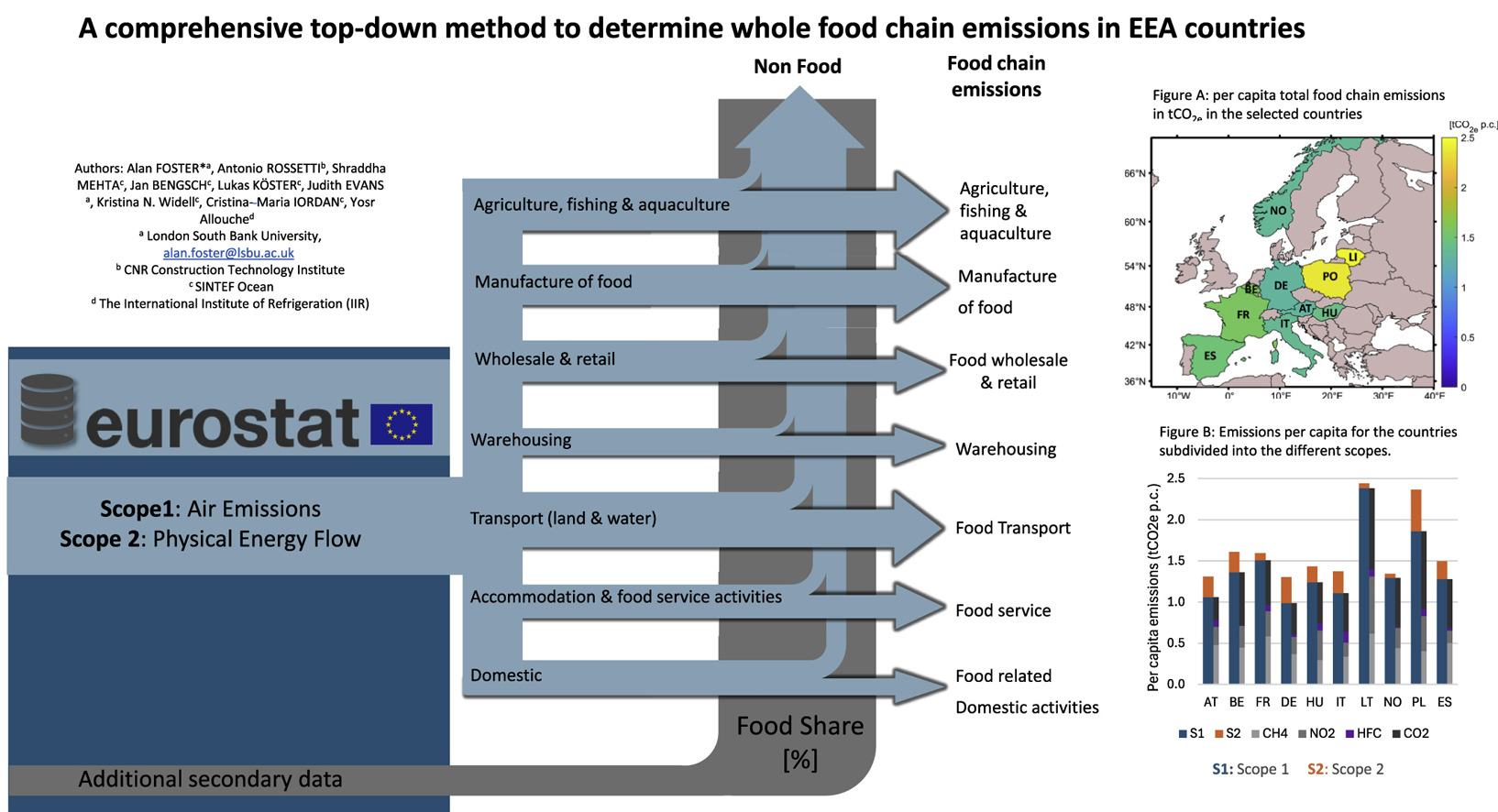
Pour plus d’informations, l’article est disponible en libre accès dans la revue Journal of Cleaner Production et dans FRIDOC.
Source
Foster, A., Rossetti, A., Mehta, S., Bengsch, J., Köster, L., Evans, J., Widell, K.N., Iordan, C.-M., Delahaye, A., Allouche, Y., 2025. A comprehensive top-down method to determine food chain emissions in European Economic Area countries. Journal of Cleaner Production 534, 147034. https://doi.org/10.1016/j.jclepro.2025.147034