
 Share
ShareRecent ENOUGH project publication on food sector emissions provides objective comparison across EU countries, sector and emission scopes
A team of researchers from the ENOUGH consortium (London South Bank University – UK, CNR Construction Technology Institute – Italy, SINTEF Ocean – Norway, INRAE – France, IIR) recently published a comprehensive top-down methodology and data set for establishing GHG emissions from the food chain (excl. animal feed) for 10 European countries.
The ENOUGH project aims to support the EU’s sustainable farm to fork strategy by providing technical, financial and political tools and solutions to reduce GHG emissions and achieve climate neutrality in the food industry.
Under the United Nations Framework Convention on Climate Change (UNFCCC), parties are required to report annual inventories of their GHG emissions, which include emissions from food systems, embedded in several Intergovernmental Panel on Climate Change (IPCC) sectors. Several databases exist to quantify food sector emissions specifically. However, the aggregated data does not provide enough granularity and policy relevance to assess the differences between individual countries that can allow the recommending of country specific mitigation measures.
A team of researchers from the ENOUGH consortium (London South Bank University – UK, CNR Construction Technology Institute – Italy, SINTEF Ocean – Norway, INRAE – France, IIR) recently published an article in the Journal of Cleaner Production which provides a comprehensive top-down methodology and data set for establishing GHG emissions from the food chain (excl. animal feed) for EU member states and EEA countries.
Emissions for 10 EU countries (Austria, Belgium, France, Germany, Hungary, Italy, Lithuania, Norway, Poland and Spain) were categorised by food sectors and emission scopes. The following key points were identified regarding Scopes and Country total and per-capita emissions:
- The food share emissions as a proportion of each country total GHG emissions varied from 10 % for Norway and Germany to 24 % for Lithuania. This correlates well with the per capita emission from these countries showing that the increased food share is related to increase per capita emission from the food sector.
- Scope 1 emissions dominated and were higher than Scope 2 emissions for all countries and for all major food sectors, contributing 84 % of the total food GHG emissions for the 10 countries. This shows the need to reduce direct fossil fuel use in each link of the food chain.
- HFC emissions are a small proportion of total food emissions (5 %), however, this is not the case in retail, where they account for 50 % of retail emissions and 66 % of HFC emissions occur in retail. This highlights the need for retailers to concentrate on reducing their HFC emissions. Natural refrigerants are an available technology in retail that can effectively replace HFC use and reduce to zero, this Scope 1 emission contribution. The latest European f-gas regulation will likely force retailers in this direction.
- Scope 2 emissions were very dependent on the electrical carbon grid emission intensity of the countries, which are very low in Norway, Lithuania and France (<0.07 kg/kWh) and very high in Poland (0.776 kg/kWh). However, these low grid intensities did not lead to low total food emissions in France and Lithuania. This is because the Scope 1 emissions were high in these countries.
This study presents a consistent approach to investigate the emissions at a relatively disaggregated level, making it better suited for monitoring progress toward climate targets and informing targeted country-level mitigation strategies.
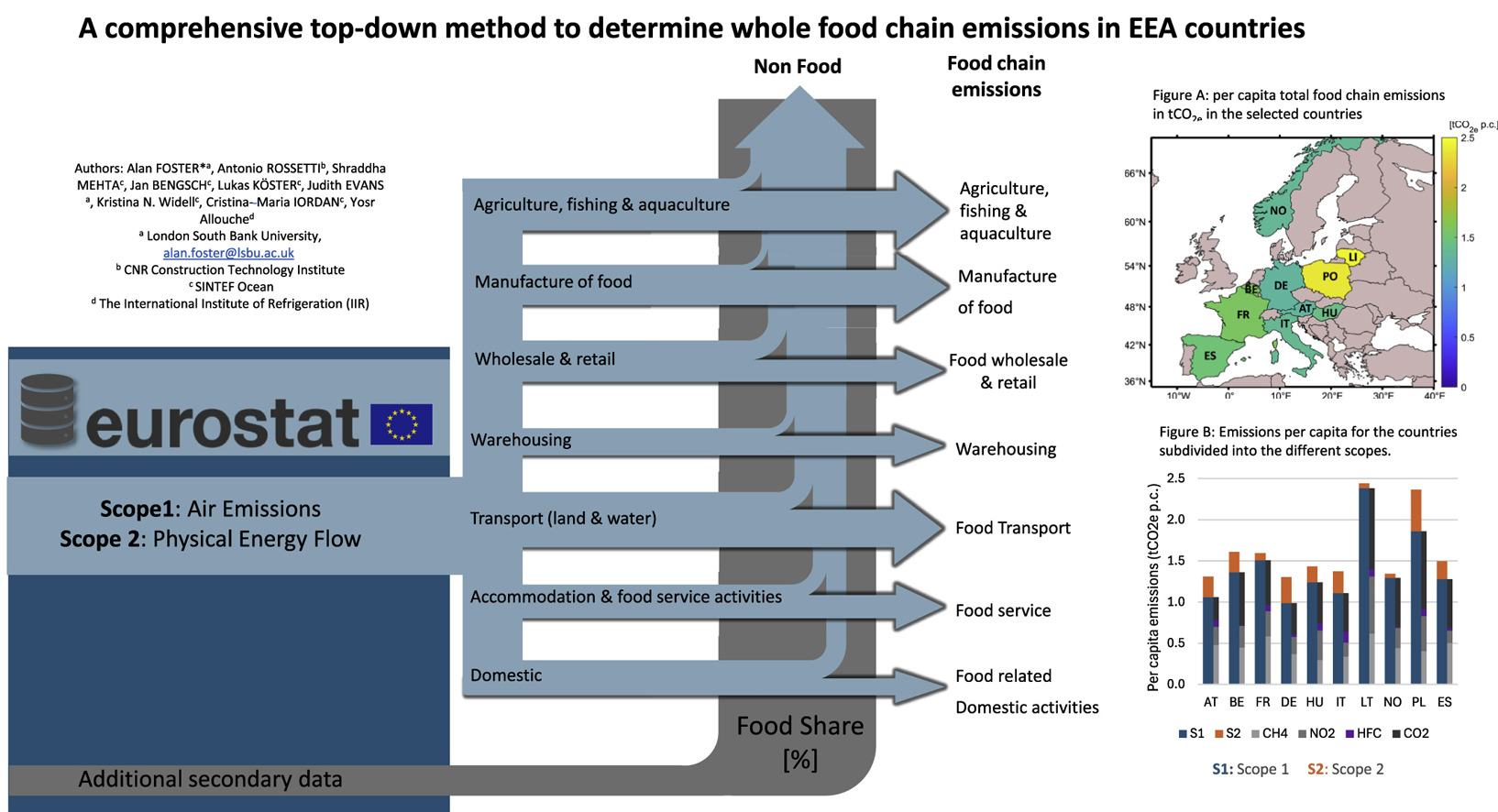
For more information, the article is available in open access in the Journal of Cleaner Production and on FRIDOC.
Source
Foster, A., Rossetti, A., Mehta, S., Bengsch, J., Köster, L., Evans, J., Widell, K.N., Iordan, C.-M., Delahaye, A., Allouche, Y., 2025. A comprehensive top-down method to determine food chain emissions in European Economic Area countries. Journal of Cleaner Production 534, 147034. https://doi.org/10.1016/j.jclepro.2025.147034