
 Share
ShareIndia: NCCD reports a 2.2% compound annual growth rate in cold storage capacity
Reports from the Government of India – Press Information Bureau (PIB) and from the Indian Ministry of Agriculture and Farmers Welfare – National Centre for Cold-Chain Development (NCCD) document the growth of cold storage capacity and refrigerated transport in India and estimate future capacities towards 2031.
India is marked by a increasing demand for both raw and processed food. An efficient and widespread storage infrastructure plays a key role in linking farms to markets and empowering farmers to realize better returns, as well as maintaining year-round availability of essential commodities, securing buffer stocks, reducing product wastage and extending its shelf life, and stabilizing prices.
In particular, cold storage is essential in preserving perishable foodstuff such as fruits, vegetables, dairy products, meat and seafood. Cold chain infrastructure includes facilities for pre-cooling, weighing, sorting, grading, packaging, Controlled Atmosphere (CA) storage, blast freezing, and refrigerated transport.
Cold storage infrastructure
According to the Government of India - Press Information Bureau (PIB)[1], as of June 30, 2025, India has 8,815 cold storages with a combined capacity of 402.18 lakh metric tonnes (LMT), corresponding to 40.22 million metric tonnes, to help preserving perishable products nationwide.
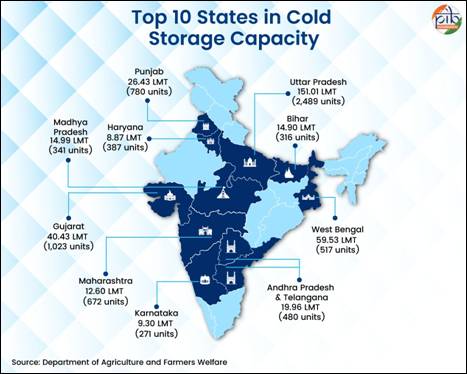
Figure 1. Cold storage capacity distribution in India [1].
In another recent report from the Indian Ministry of Agriculture and Farmers Welfare – National Centre for Cold-Chain Development (NCCD)[2], published in September 2025, data on cold storage capacity in 2015[3], 2020[4] and 2024[2] were utilised to estimate the projected future Indian cold storage capacity. Extrapolation from historical data projected a total cold storage capacity in 2031 equal to almost 440 LMT, corresponding to an estimated Compound Annual Growth Rate (CAGR) of approximately 2.2%.
Refrigerated transport
Reefer trucks are specialised vehicles used to transport perishable goods under controlled-temperature conditions. Despite playing a key role in India’s cold supply chain, refrigerated transport remains underutilised compared to the nation needs. Reefer vehicles predominantly serve export-oriented perishables and industries that require stringent temperature controls, such as dairy and processed foods.
According to NCCD[3], approximately 9,000 reefer vehicles were in operation in 2015, primarily observed near urban and semi-urban regions, with an 85% infrastructure gap. More recent data[5] confirm such figures, reporting a total number of refrigerated vehicles in operation in India equal to approximately 10,000 units, against an estimated need of at least 62,000 units to guarantee smooth operations across the country.
In their latest report[2], NCCD highlighted the crucial importance of developing an enhanced network of temperature-controlled transport, by investing in refrigerated trucks and rail systems through public-private partnerships, promoting the development and use of smart logistics tools such as IoT-enabled tracking systems, and establishing regional aggregation centres to improve localised distribution. NCCD also estimates that the number of reefer vehicles in India might increase up to approximately 33,000 units by 2031[2]: however, on an absolute scale, these figures show how the Indian refrigerated transport sector presents significant margins for development, especially for such a large and populated nation (see our recent news on the latest estimation on the number of refrigerated transport in Europe for comparison).
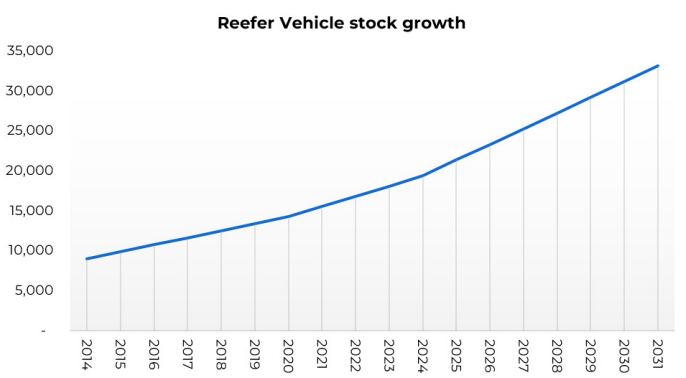
Figure 2. Reefer vehicles stock growth projection towards 2031[2].
Sources
[1] Government of India – Press Information Bureau (PIB). From harvest to home – Building resilient infrastructure for storage of food grains. September 2025. https://www.pib.gov.in/PressReleasePage.aspx?PRID=2172351®=3&lang=2
[2] Ministry of Agriculture and Farmers Welfare. National Centre for Cold Chain Development (NCCD). Energy transition in cold chain infrastructure. September 2025. https://nccd.gov.in/uploads/ET_in_cold_chain_sector_in_India_v8_3bfe3b8148.pdf
[3] Ministry of Agriculture and Farmers Welfare. National Centre for Cold Chain Development (NCCD). All India Cold-chain Infrastructure Capacity – Assessment of Status & Gap. August 2015. https://nccd.gov.in/uploads/All_India_Cold_Chain_Infrastructure_2015_5da1279baa.pdf
[4] Efficiency for Access Coalition. Assessment of Cold-Chain market in India. March 2023. https://www.clasp.ngo/wp-content/uploads/2023/06/Assessment-of-the-Cold-Chain-Market-in-India.pdf
[5] Food&Beverage News (FnBnews.com). India’s cold storage leap: driving food security. October 2025. https://www.fnbnews.com/Special-Reports/indias-cold-storage-leap-driving-food-security-85109