
 Share
ShareWaste heat in Europe: untapped potential and evolving policy framework
Large volumes of excess heat remain underutilised across Europe, while EU legislation is increasingly recognising its role in decarbonisation.
A vast but underused energy resource
Waste heat recovery is gaining attention as industries seek cost-effective pathways to decarbonisation. Across the EU, excess heat is estimated at around 245 Mtoe per year [1], equivalent to the total energy demand for space heating and hot water in residential and service sector buildings. This highlights a significant opportunity to reuse energy that would otherwise be lost.
Industrial processes are a major source of this potential, with process heating accounting for nearly half of industrial energy use in Europe. However, despite its scale, waste heat remains largely underexploited due to technical, economic and infrastructural barriers. Challenges include the mismatch between heat supply and demand, limited district heating networks, high upfront investment costs, and difficulties in data availability and stakeholder coordination.
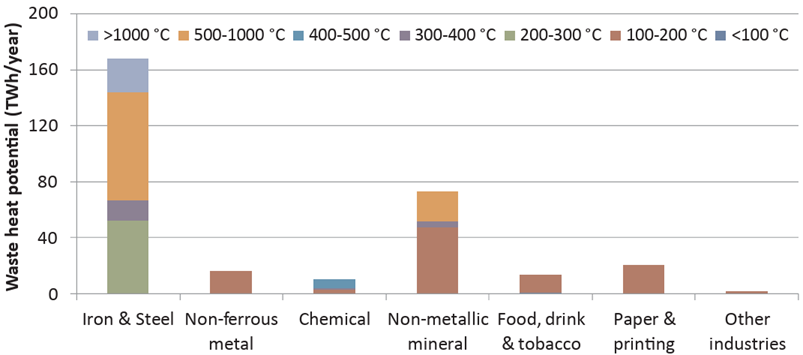
Figure 1. Estimation of technically available resources in EU, per industrial sector. [2]
How EU legislation defines waste heat
Within the framework of the European Green Deal, waste heat has gained increasing prominence in EU legislation, particularly in the Renewable Energy Directive (RED III) and the Energy Efficiency Directive (EED III). These directives require Member States to integrate waste heat into national decarbonisation strategies and assess its potential applications.
RED III defines waste heat as: “Unavoidable heat or cold generated as a by-product in industrial or power generation installations, or in the tertiary sector, which would otherwise be dissipated unused into the air or water without access to a district heating or cooling system, where a cogeneration process has been used or will be used or where cogeneration is not feasible." The directive also sets conditions under which waste heat can contribute to renewable energy targets: for example, only waste heat delivered through district heating networks and sourced externally can be counted, and even then within specific limits.
EED III builds on this definition and introduces requirements for assessing waste heat recovery in industrial installations and data centres, as well as promoting its integration into efficient district heating systems. Together, these directives aim to create a policy framework that supports the uptake of waste heat recovery technologies.
Challenges in definitions and emerging initiatives
Despite this progress, some scientists from the Energy Institute at the Johannes Kepler University in Linz, Austria, pointed out some inconsistencies in the current EU definition of waste heat in their article published on Utilities Policy [3], highlighting excessive complexity and connection to district heating applications. The scientists state that the EU definition does not fully align with technical definitions used in research and may exclude certain sources or uses, such as internal heat recovery within industrial sites. Additionally, its dependency on district heating infrastructure can limit practical implementation, especially in regions where such networks are underdeveloped.
Another point of debate concerns the classification of waste heat in relation to renewable energy. While EU legislation often treats waste heat similarly to renewables in accounting frameworks, it is not inherently a renewable resource, leading to ambiguity in policy interpretation.
To address these gaps and support implementation, research and innovation initiatives are advancing both technologies and policy recommendations. The RE-WITCH project [1,4], for example, is developing and demonstrating thermally driven cooling and heating solutions, such as absorption and adsorption systems, designed to valorise waste heat in industrial processes. Alongside technology demonstration, the project contributes to refining policy frameworks and facilitating market uptake.
Overall, aligning legal definitions with technical realities, while supporting infrastructure and innovation, will be key to unlocking the full potential of waste heat in Europe’s energy transition.
Sources:
[1] Institute for European Energy and Climate Policy (IEECP). Understanding the regulations governing waste heat & cooling technologies [Brief]. August 2025. https://ieecp.org/publications/understanding-the-regulations-governing-waste-heat-and-cooling-technologies-brief/
[2] Papapetrou, M., Kosmadakis, G., Cipollina, A., La Commare, U., Micale, G. (2018). Industrial waste heat: Estimation of the technically available resource in the EU per industrial sector, temperature level and country. Applied Thermal Engineering 138, 207-216. https://doi.org/10.1016/j.applthermaleng.2018.04.043
[3] Holzleitner-Senck, M.T., Moser, S., Denk, M. (2025). Waste heat inconsistencies in the EU's energy legislation. Utilities Policy 93, 101880. https://doi.org/10.1016/j.jup.2024.101880
[4] Institute for European Energy and Climate Policy (IEECP). RE-WITCH – The coolest cold from the cleanest heat. https://ieecp.org/projects/re-witch/