
 Share
ShareBETTED: Dairy case studies highlight opportunities for energy and cost savings
Two studies illustrate the potential energy savings, environmental benefits and economic value of energy efficiency measures in the dairy sector. Through BETTED, the IIR invites dairy companies to assess opportunities within their operations, access tailored training and explore opportunities to showcase their achievements.
Refrigeration, cooling and process heating offer opportunities to improve energy efficiency across the dairy value chain. Identifying suitable investments requires an understanding of operating conditions, energy demand and costs.
Two studies by the University of Brescia, coordinator of BETTED, illustrate how assessment can support these decisions. Their findings highlight potential savings and the importance of evaluating each application individually.
In a study published in 2022, researchers modelled nine efficiency measures for the storage and transport stages of a dairy cold chain, from milk supplier to retail. Operational inputs came from interviews with European dairy and logistics companies, while implementation costs were obtained from equipment and measure suppliers. Energy consumption associated with the production process was not included in the cold-chain assessment.
Under the study’s assumptions, a two-stage refrigeration system offered the shortest projected simple payback, at 1.1 years, and the highest projected net present value, at €576,074 over 20 years, using a 4% discount rate.
Free cooling, which uses favourable outdoor conditions to reduce mechanical refrigeration demand, and maintenance, which keeps equipment operating efficiently through cleaning, inspection and repairs, had projected paybacks of 3.1 and 5.2 years, respectively. Waste heat recovery had a longer payback of 11.4 years. Across all nine measures, combined projected savings reached approximately €200,000 annually, based on an energy price of €0.12/kWh.
The second study examined heat pump integration at a plant processing whey from Parmigiano Reggiano production. A modelled cooling-only replacement was projected to reduce electricity consumption by approximately 31% for the directly supplied chiller load assessed.
A heat-recovery configuration required more electricity than both the baseline and cooling-only option, but offered greater projected annual operating-cost savings by displacing boiler gas consumption. The authors treat these benefits as upper-bound estimates: the assumed use of 60% of condenser heat remains to be validated against measured process-heating demand.
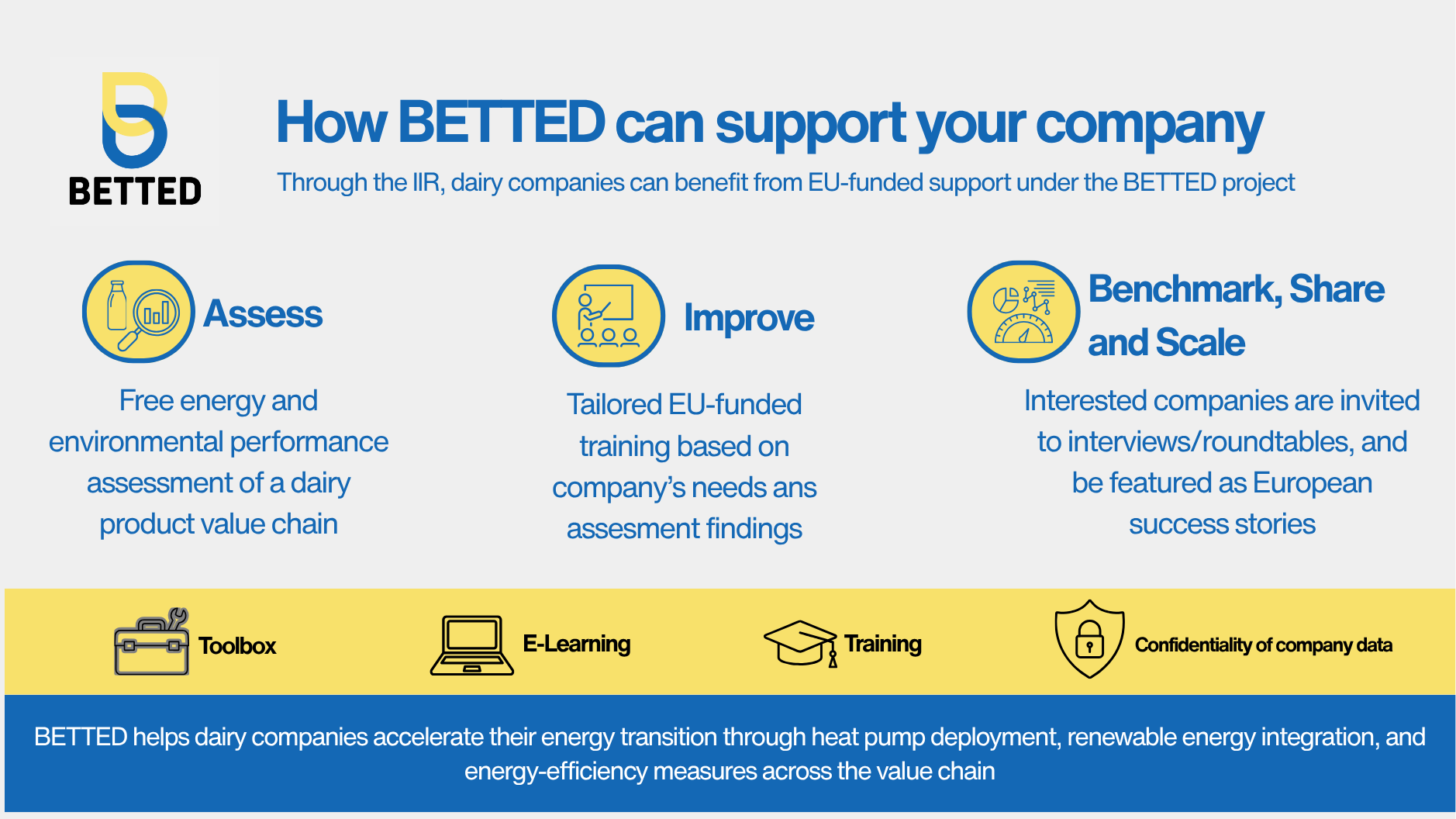
These findings illustrate the types of opportunities BETTED helps companies assess. Through the IIR, participation combines assessment, training and knowledge exchange:
- Assess: a free review using the BETTED Toolbox to benchmark the dairy value chain and identify potential energy and cost savings.
- Improve: tailored, EU-funded training informed by the assessment, covering relevant topics such as refrigeration, heat recovery, heat pumps and renewable energy.
- Benchmark, Share and Scale: Opportunities to connect with peers, exchange best practices, and gain visibility for energy efficiency success stories through BETTED project communications, IIR publications, and the IIR website.
** Company data are handled confidentially, with a non-disclosure agreement available on request before detailed information is shared.
The IIR welcomes expressions of interest from Europe-based dairy companies and organisations across the value chain. Participation offers an opportunity to examine current performance, explore suitable technologies and strengthen the knowledge needed for investment decisions.
Express your interest in BETTED assessment and training.
BETTED — Boosting Energy Transition of The Dairy value chain — is co-funded by the European Union’s LIFE Clean Energy Transition programme, grant agreement No. 101120856.
Sources:
- Marchi, B., Bettoni, L. and Zanoni, S. “Assessment of Energy Efficiency Measures in Food Cold Supply Chains: A Dairy Industry Case Study.” Energies, 2022, 15, 6901. Section 4 and Table 4.
- Marchi, B., Lysova, N., Solari, F., Zanoni, S., Neri, A., Chinese, D., Marchesano, M.G., Cagno, E. and Guizzi, G. “Data-driven Seasonal Performance Evaluation of Heat Pump Integration for Cold Thermal in Industrial Whey Processing.” Results, Table 3 and Section 6.