
 Share
ShareIIR launched a new technical brief on dehumidification at the OEWG48 side event in Bangkok
Bangkok, 14 July 2026 — The International Institute of Refrigeration (IIR) officially launched its latest technical publication, Dehumidification in Air Conditioning, at a side event held during the 48th Meeting of the Open-Ended Working Group (OEWG48) to the Montreal Protocol, taking place at the United Nations Conference Centre (UNCC) in Bangkok.
Co-organised with the Chinese Association of Refrigeration (CAR), the event brought together researchers, industry representatives and policymakers for an evening dedicated to one of air conditioning's most energy-intensive and most overlooked functions: removing moisture from the air.
Why Dehumidification Matters
Dehumidification is responsible for more than half of the cooling load, and the associated energy use, in many air conditioning systems, particularly in hot and humid climates. As cooling demand accelerates across Southeast Asia and other tropical regions, efficient humidity control is increasingly recognised as central to limiting the energy and climate footprint of that growth. By convening researchers, industry and policy voices in the same room, the side event aimed to sharpen the conversation on how faster deployment of efficient dehumidification technologies can support both climate mitigation and adaptation goals under the Montreal Protocol.
Inside the Session
The evening opened at 18:00 with a welcome reception and networking, setting an informal tone before the formal proceedings began. Souhir Al-Hammami of the IIR welcomed participants and opened the session, followed by remarks from co-organiser Wang Congfei of CAR. Then the new publication, outlining its context and scope have been introduced for the audience.
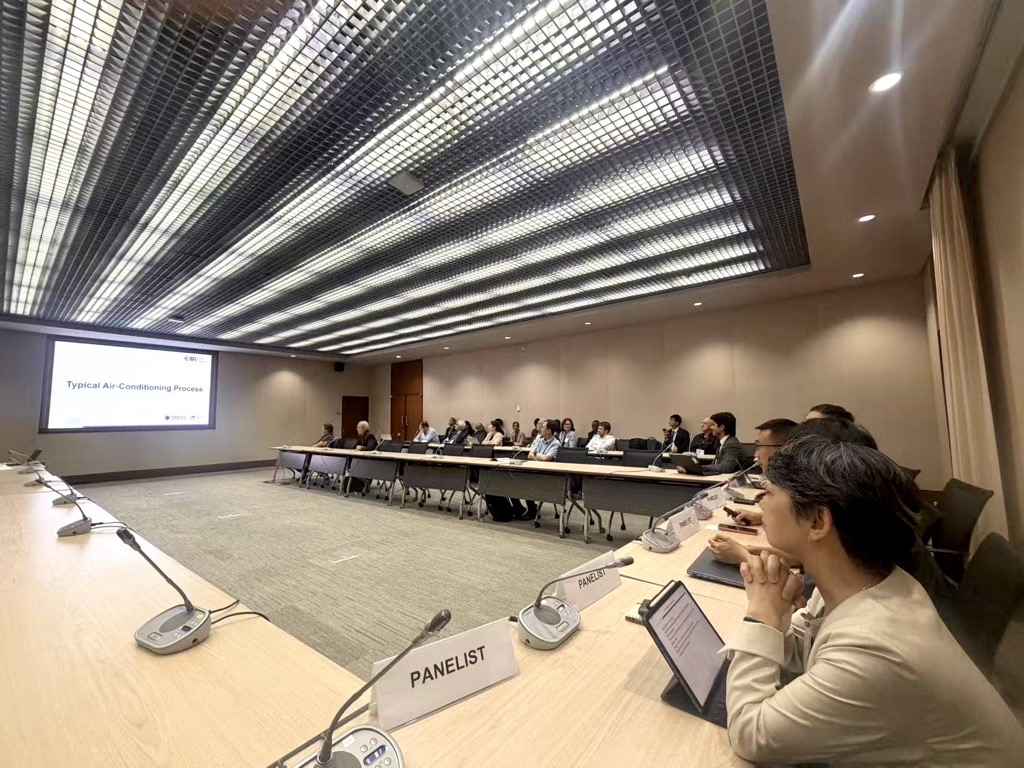
The technical heart of the evening followed, with three presentations:
- Prof. Zhang Tao (Tsinghua University) opened with an overview and comparison of air conditioning processes and dehumidification technologies, laying out the landscape from established to emerging approaches.
- Dr. Zhiyao Ma (Tsinghua University) followed with a look at emerging technologies and their industrial applications.
- Miki Yamanaka (Daikin) brought an industry perspective, addressing the practical challenges and opportunities manufacturers face in bringing efficient dehumidification to market.
Followed by Marco Duran of the IIR then presented the publication's recommendations and key actions for policymakers, translating the technical findings into guidance for regulators and international bodies. And an open Q&A session gave the floor to all speakers before Zhao Na of CAR delivered closing remarks and outlined next steps, bringing the event to a close at 20:00.
About the publication
Dehumidification in Air Conditioning is the 62nd installment in the IIR's Technical Brief series on refrigeration technologies. It reviews condensation-based, liquid desiccant, solid desiccant and emerging dehumidification technologies, comparing their energy performance, dehumidification capability and technological maturity. The brief closes with recommendations for both industry and policymakers on accelerating the deployment of efficient dehumidification, particularly in the hot, humid regions where cooling demand is growing fastest.