
 Share
ShareNew framework aims to standardise research on evaporative cooling technologies
Evaporative cooling is gaining increasing attention as an energy-efficient alternative to conventional air conditioning. A new scientific study by an international team of researchers, including Anna Pacak, Research Fellow at IIR, proposes a unified classification of evaporative coolers and introduces benchmark datasets to improve the validation of performance models.
Growing interest in evaporative cooling
As global demand for indoor cooling continues to rise, researchers are exploring alternatives to conventional air conditioning systems based on vapour-compression cycles. These traditional systems consume large amounts of energy and rely on refrigerants that can contribute to greenhouse gas emissions.
Evaporative cooling technologies offer a promising alternative. By exploiting the natural process in which water evaporation absorbs heat from the surrounding air, these systems can reduce air temperature with significantly lower energy consumption and without the use of synthetic refrigerants. They also avoid the need for outdoor units that release heat into the environment, helping mitigate the urban heat island effect.
However, despite the growing number of evaporative cooling technologies and modelling approaches developed in recent years, the scientific literature lacks unified terminology and standardised datasets. This makes it difficult to compare different configurations and validate simulation models used to predict system performance. A new study [1], recently published on Applied Thermal Engineering by an international team of researchers from the University of Liege, Belgium, the Reims Champagne-Ardenne University, France, and the Wroclaw University of Science and Technology, Poland, including Anna Pacak, Research Fellow at IIR, addresses this gap by proposing a comprehensive classification of evaporative coolers and providing benchmark datasets for model validation.
Main types of evaporative coolers
The study proposes the following classification of evaporative coolers based on how the evaporation process is used to cool the air:
- Direct evaporative coolers (DEC): In these systems, air is cooled directly through contact with water in wet channels. As water evaporates, it absorbs heat from the air, reducing its temperature while increasing its humidity.
- Indirect evaporative coolers (IEC): These systems cool air without adding moisture. Heat is transferred through a heat exchanger between a primary air stream and a secondary air stream where evaporation takes place.
- Dew-point indirect evaporative coolers (D-IEC): A variation of IEC systems in which part of the cooled primary air is recirculated and used as secondary air. This configuration can achieve lower temperatures, approaching the dew point of the incoming air.
- Maisotsenko indirect evaporative coolers (M-IEC): These devices introduce an additional dry channel on the secondary side to further reduce the achievable cooling temperature and improve efficiency.
- Perforated configurations (Perforated D-IEC and Perforated M-IEC): Some IEC variants include perforated walls between channels to promote air mixing and enhance evaporation processes.
- Two-stage evaporative coolers: These combine different evaporative cooling stages, such as IEC and DEC, in a single system to improve overall performance.
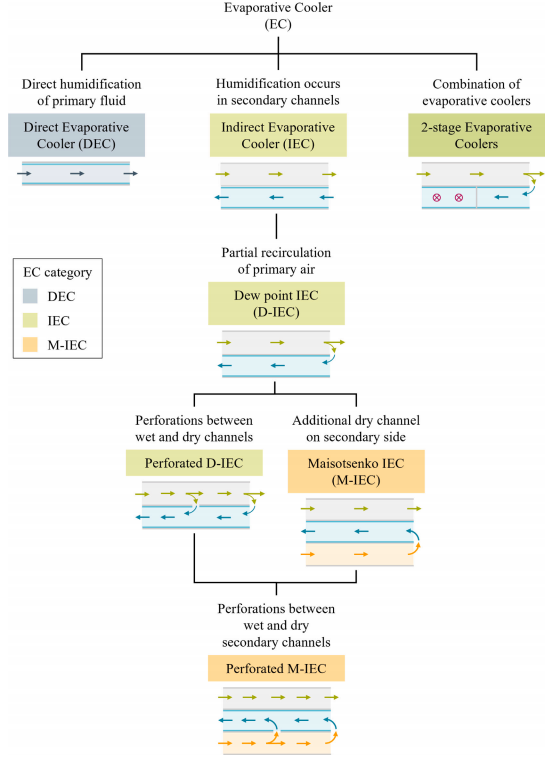
Figure 1. Classification of evaporative coolers proposed by the researchers [1].
A new framework for model validation
Beyond this classification, the paper proposes a structured framework to support the validation of numerical models used to simulate evaporative cooling systems. Model validation is essential for ensuring that simulations accurately predict system behaviour under different operating conditions.
To support this process, the researchers compiled 18 standardised datasets derived from experimental and numerical studies available in the literature. These datasets cover seven evaporative cooler configurations and include more than 1,300 data points, representing a wide range of temperatures, humidity levels and operating conditions.
All datasets are organised using a unified terminology and are available through an open-source online database [2], enabling researchers to test and compare models more easily. According to the authors, this collaborative resource could help improve consistency in future studies and accelerate the development of more efficient evaporative cooling technologies.
For more information, the scientific paper is available on Applied Thermal Engineering and open access on FRIDOC.
Sources:
[1] Zeoli, A., Gendebien, S., Janod, T., Moussa, T., Maalouf, C., Pacak, A., Lemort, V. (2026). Towards reliable model validation of evaporative coolers: Unified terminology and benchmark datasets. Applied Thermal Engineering, Volume 289, Part 3, 129928. https://doi.org/10.1016/j.applthermaleng.2026.129928