
 Share
ShareGermany: IIR Junior Member C. Vering shows heat pumps can cut GHG emissions by 91%
C. Vering, C. Zibunas, et al. investigated the environmental performance of switching from boilers to heat pumps in residential buildings across Germany using life cycle assessment, in a study published recently in Cell Reports Sustainability.
After record sales in 2021 and 2022, the European Heat Pump Association (EHPA) recorded declining sales in several European countries in 2023 and 2024. According to EHPA, Germany is one of the European countries where heat pumps currently represent a low market share in space heating.
In a study published in August 2025 in Cell Reports Sustainability, a team of researchers from Aachen University, Germany, assessed the environmental impacts of heat pumps and refrigerants compared with conventional gas heating, also in environmental categories beyond climate change. IIR Junior Member Christian Vering and colleagues conducted a life cycle assessment (LCA) from cradle-to-grave including refrigerant production, heat pump production, heat pump operation, the impact of refrigerant leakage during production and operation, and upstream processes, e.g. the provision of materials and energy.
Climate change mitigation potential of switching from gas boilers to heat pumps
Findings revealed that heat pumps can achieve a climate change mitigation potential of up to 91% compared with gas boiler heating (see Figure 1). The GHG reduction potential was estimated at up to –48% in a very conservative baseline scenario, increasing to up to –91% when combining the use of renewable electricity with energy-efficient buildings and heat pumps.
The mitigation potential in ascending order was mainly sensitive to three factors: residential building efficiencies, heat pump efficiency due to refrigerant selection, and electricity generation for the heat pump operation.
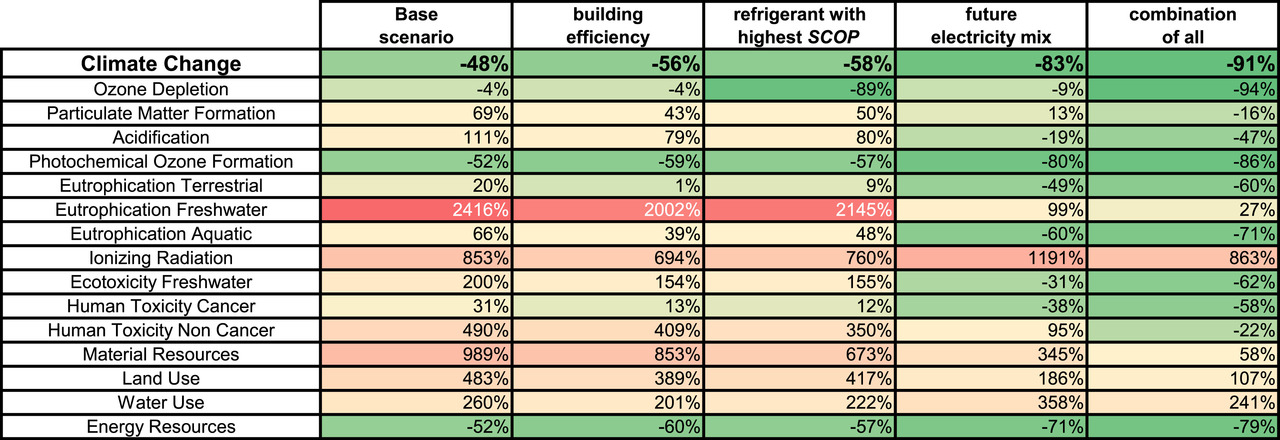
The baseline scenario consists of a building simulation of a three-story house in Germany built on average between 1919 and 1949. The heat pump is powered by the German electricity grid mix 2019 and achieves a seasonal coefficient of performance (SCOP) of 3.5 using refrigerant R410A. “Future electricity mix” represents an electricity forecast.
Authors’ recommendations for a more sustainable residential heating sector
Summing up the main findings of this study, the authors suggest the following recommendations:
(1) When to switch from boiler to heat pump and to which refrigerant?
- From an environmental perspective, now, even in very conservative scenarios, choose a heat pump instead of a boiler already today to mitigate climate change.
(2) Which is an adequate hierarchy toward a more sustainable heating sector?
- Push renewable electricity with corresponding grid expansion.
- Push heat pumps with the highest efficiency, exploiting their potential (e.g., using R290 as a refrigerant based on our assessment).
- Push renovation of buildings, reducing the demand and heating temperature.
(3) Which challenges are highlighted due to the in-depth assessment?
- If several refrigerants are hastily prohibited, there might be a conflict between the remaining refrigerants in products and safety standards, which must be reassessed.
- If grid mixes, heat pump efficiencies, and building efficiencies improve, heat pump construction will have a major impact on several categories that are subject to burden shifting. Introducing a circular economy for heat pumps seems promising for exploiting the entire potential of heat pumps in buildings and reducing remaining burden shifting.
- We need trained experts to plan, commission, and maintain efficient heat pumps, avoiding a bottleneck in energy transition in the upcoming years.
The complete study is available in open access in Cell Reports Sustainability and FRIDOC.