
 Share
ShareIEA 2026 electricity report: global electricity demand rises, with cooling among key growth drivers
The 2026 global electricity report from the International Energy Agency (IEA) forecasts rapid growth in power use through 2030, driven by electrification, digitalisation and rising cooling needs. The report warns that stronger grids, greater flexibility and major investment will be essential to keep systems reliable and affordable.
Electricity demand enters a new growth era
As assessed in the 2026 annual report on global electricity systems and markets by the International Energy Agency (IEA), “Electricity 2026 – Analysis and forecast to 2030”[1], published in February 2026, the global power demand is expected to rise sharply over the rest of the decade. The agency projects that the global electricity demand will grow by an average of 3.6% per year between 2026 and 2030, approximately 50% faster than the average increase seen over the previous decade.
This surge reflects what the report calls the “Age of Electricity”. Power use is expanding across industry, transport and buildings as countries electrify more of their economies. At the same time, new sources of demand are emerging from fast-growing sectors such as artificial intelligence, data centres, electric vehicles and air conditioning. For the first time in three decades, outside crisis periods, electricity demand has begun to grow faster than the global economy, a shift expected to continue through 2030.
Emerging economies will account for nearly 80% of additional consumption through 2030, with China alone responsible for about half of global growth. India and Southeast Asia are also set to play a larger role, driven by economic expansion and rising cooling needs. Meanwhile, electricity demand in advanced economies is accelerating again after years of stagnation, supported by digital infrastructure, advanced manufacturing and electrification. In 2025, advanced economies accounted for approximately 20% of global electricity demand increase, and this value is expected to remain stable in the next five years.
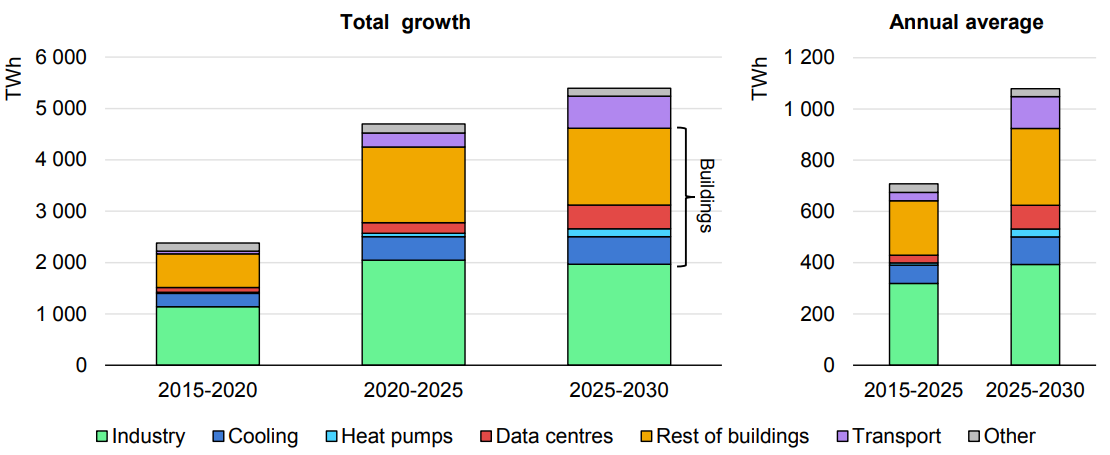
Figure 1. Global electricity demand growth by sector and end-use[1].
Cleaner power rises, but grids face mounting pressure
On the supply side, low-emissions sources are expanding rapidly. Renewable electricity generation is expected to grow by approximately 1,000 TWh each year through 2030, rising with an annual rate of 8% per year and with solar power alone accounting for more than 60% of the total generation increase. Together, renewables and nuclear energy are projected to provide about 50% of the world’s electricity by the end of the decade.
Despite this shift, coal is likely to remain the single largest source of electricity globally, even as its overall share gradually declines. Additional demand over the next five years is expected to be met entirely by renewables, natural gas and nuclear, helping power-sector carbon emissions decrease.
The rapid transformation is putting new strain on electricity networks. More variable solar and wind generation, combined with concentrated new loads such as data centres and electric vehicle charging, requires far more flexible power systems. At the same time, more than 2,500 GW worth of projects, including renewables, storage and large loads such as data centres, are currently waiting to connect to grids worldwide.
To keep pace with demand, the report estimates that annual grid investment must rise by around 50% by 2030 from today’s level of roughly $400 billion. Alongside network expansion, measures such as advanced grid technologies, flexible connection agreements and large-scale battery deployment could unlock significant additional capacity and improve system efficiency.
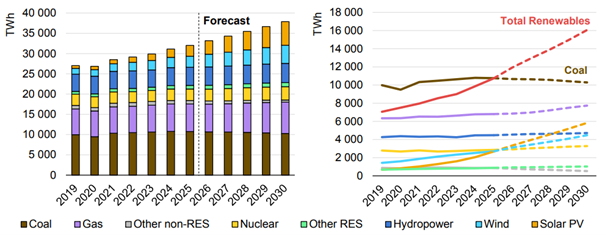
Figure 2. Global electricity generation by source[1]. (RES: renewable energy sources)
Affordability, resilience and security should become a primary focus
As electricity becomes more central to modern economies, affordability and reliability are emerging as key policy concerns. In many countries, household electricity prices are rising faster than incomes since 2019, and regional price differences are creating competitive challenges for energy-intensive industries. Policymakers are increasingly focused on market reforms and demand-side flexibility to keep costs under control while supporting electrification.
At the same time, recent large-scale outages have highlighted growing risks from ageing infrastructure, extreme weather, cyber threats and other vulnerabilities. Strengthening grid resilience, modernising system operations and securing supply chains will be critical as electricity dependence deepens.
Overall, the report depicts current years as a future-defining period in which electricity is becoming the backbone of economic growth, but only if investment, flexibility and reliability keep pace with rising demand.
For more information, the full report is available in open access in the IEA website.
Source
[1] International Energy Agency (IEA). Electricity 2026 – Analysis and forecast to 2030. February 2026. https://www.iea.org/reports/electricity-2026