
 Share
ShareJordan launches National Cooling Action Plan to address emissions from refrigeration sector
The Kingdom of Jordan’s Ministry of Environment has official launched a National Cooling Action Plan to enable Jordan to reduce greenhouse gas emissions from refrigeration (domestic, commercial and industrial refrigeration, cold chain as well as stationary and mobile air conditioning) while promoting access to sustainable cooling.
In April 2026, the Kingdom of Jordan officially launched its National Cooling Action Plan (NCAP), an essential framework for the implementation of strategic measures identified earlier in the 2024 Jordanian National Cooling Strategy (NCS). The NCAP is the first dedicated cooling policy instrument in Jordan to simultaneously address both direct (HFC) emissions and indirect emissions from the energy consumption of refrigeration equipment, filling a gap left by existing documents that treat these two dimensions separately.
Jordan’s NCAP covers measures such as enhancing building designs for passive cooling, reducing the consumption and leakage of high GWP refrigerants, and promoting energy-efficient appliances. The document provides data on the country’s refrigeration demand and emissions, in order to support evidence-based policymaking to address cooling challenges.
GHG emissions from Jordan’s refrigeration sector
Driven by growing installation in new and existing buildings and replacement of outdated systems the refrigeration and air conditioning (RAC) market in Jordan is expected to expand at a compound annual growth rate of up to 4% between 2025 and 2027.
According to modelling, the RAC sector currently accounts for around 5% of total GHG emissions in Jordan.
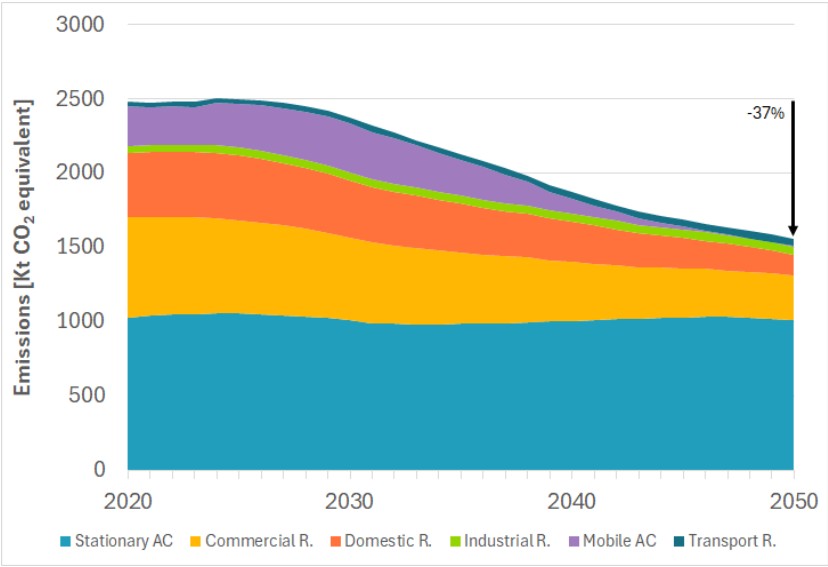
Under a BAU scenario, the number of air conditioning systems is expected to triple by 2050. However, with technology improvements in energy efficiency, a shrinking grid emission factor, and a transition to natural refrigerants, total emissions under a BAU scenario are expected to fall by 37% compared to 2020 (see figure).
The most significant decrease is expected in indirect emissions (-52%), supported by energy policy and the decarbonisation of the grid through renewable energy generation capacity. Direct emissions are projected to decrease by 14% in 2050 compared to 2020.
Key objectives from Jordan’s NCAP
Driven by the overarching target of reducing direct and indirect emissions from its refrigeration sector, Jordan’s NCAP prioritises the following measures:
- Achieving a reduction in cooling load via passive cooling measures in buildings and energy efficient RAC equipment.
- Accelerating the uptake of natural refrigerants and quickly phasing out refrigerants with the highest GWP levels.
- Building capacity and skills in the RAC service sector to ensure safe handling of natural refrigerants and improving maintenance to reduce refrigerant leaks.
- Raising awareness around the use of natural refrigerants and energy efficiency in cooling equipment.
- Reducing leakage rates and waste via improved life cycle and end-of-life management.
- Financing and incentivising the sustainable cooling transition via government and private sector financial instruments.
The NCAP details a short-, mid- and long-term framework to empower sector stakeholders to implement these measures between 2025 and 2040.
For more information, Jordan’s NCAP is available for download on the Ministry of Environment’s website and on FRIDOC.