
 Share
Reverse Brayton cycle high-temperature heat pumps could deliver industrial heat at temperatures up to 350°C
A recent review by researchers from the National Technical University of Athens and the University of West Attica, Greece, examines the performance, economic potential and technical challenges of high-temperature heat pumps based on reverse Brayton cycles, highlighting their potential for industrial decarbonisation.
Reverse Brayton cycles for high-temperature industrial heating
A recent review [1] published on Applied Thermal Engineering by a team of researchers from the National Technical University of Athens and the University of West Attica, Greece, investigates the potential of high-temperature heat pumps (HTHPs) based on the reverse Brayton cycle to support the electrification and decarbonisation of industrial heating processes.
Unlike conventional vapour-compression heat pumps, reverse Brayton systems operate through a gas cycle without evaporation or condensation of the working fluid. Heat is absorbed from a lower-temperature source, upgraded through compression and delivered at a higher temperature, while an expansion turbine recovers part of the mechanical work, reducing the overall electricity consumption.
The review focuses particularly on air and CO₂ as working fluids, comparing their thermodynamic performance, operating conditions and economic characteristics. Reverse Brayton HTHPs can deliver heat at temperatures of up to 300-350°C, extending the range of industrial applications that can potentially be served by heat pump technologies.
Performance, economic potential and future challenges
According to the review, air-based reverse Brayton heat pumps offer considerable operational flexibility and the ability to achieve high temperature lifts, although their coefficient of performance (COP) generally remains relatively modest, ranging from approximately 1.3 to 2.2. CO₂-based systems can achieve higher efficiencies, with COP values reaching 4.2, while also benefiting from improved heat transfer and more compact equipment. However, high operating pressures and system complexity remain important technical challenges.
From an economic perspective, the review reports specific capital costs of approximately 600-1,200 € per kW of thermal capacity, indicating that these systems can already be competitive with conventional electric heaters, and even with natural gas boilers under suitable conditions, in particular where electricity-to-gas price ratios are low. The authors also highlight opportunities to integrate reverse Brayton cycles into Carnot batteries, which store electricity as thermal energy for subsequent recovery, and into multigeneration systems.
Despite their potential, reverse Brayton HTHPs are not yet widely commercially available. The review identifies system optimisation, improved component efficiency, digitalisation, economic and life-cycle assessments, and industrial-scale demonstrations as key priorities for future development. Progress in these areas could support broader deployment of reverse Brayton technologies for high-temperature industrial heating and energy storage.
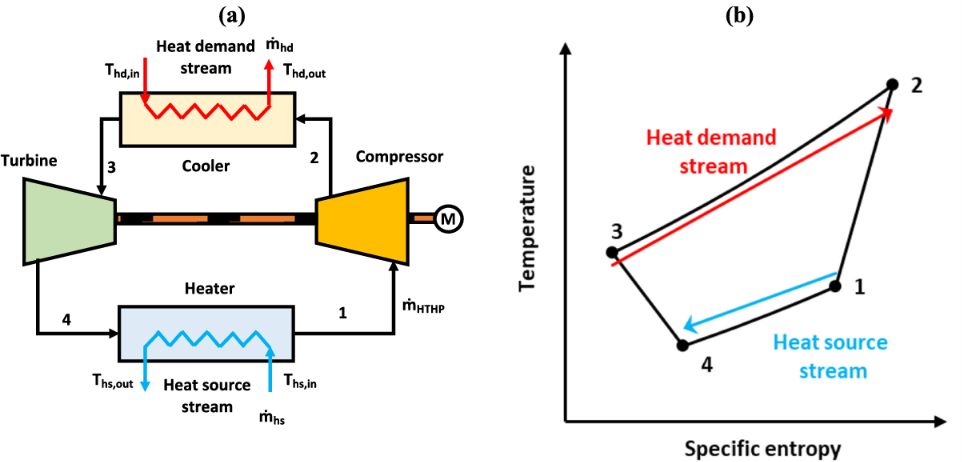
Figure. Schematic layout (a) and temperature-specific entropy diagram (b) of a typical reverse Brayton heat pump [1].
For more information, the scientific paper is available in open access in Applied Thermal Engineering.
Sources:
[1] Lykas, P., Bellos, E., Tzivanidis, C. (2026). Review of high-temperature heat pumps based on the reverse Brayton cycle. Applied Thermal Engineering 306 (2026) 133148. https://doi.org/10.1016/j.applthermaleng.2026.133148