
 Share
ShareRudolf Plank: A Lifetime in the Service of the International Institute of Refrigeration
As the Kältetechnisches Institut celebrates its centenary, we invite you to look back on the remarkable life of Rudolf Plank, whose work profoundly shaped the history of refrigeration, scientific research, and the International Institute of Refrigeration.
An Exceptional Commitment Spanning More Than Half a Century
Few individuals have left as profound a mark on the history of the International Institute of Refrigeration as Rudolf Plank. His involvement with the organisation spanned more than fifty-five years and accompanied virtually the entire modern history of refrigeration throughout the twentieth century.
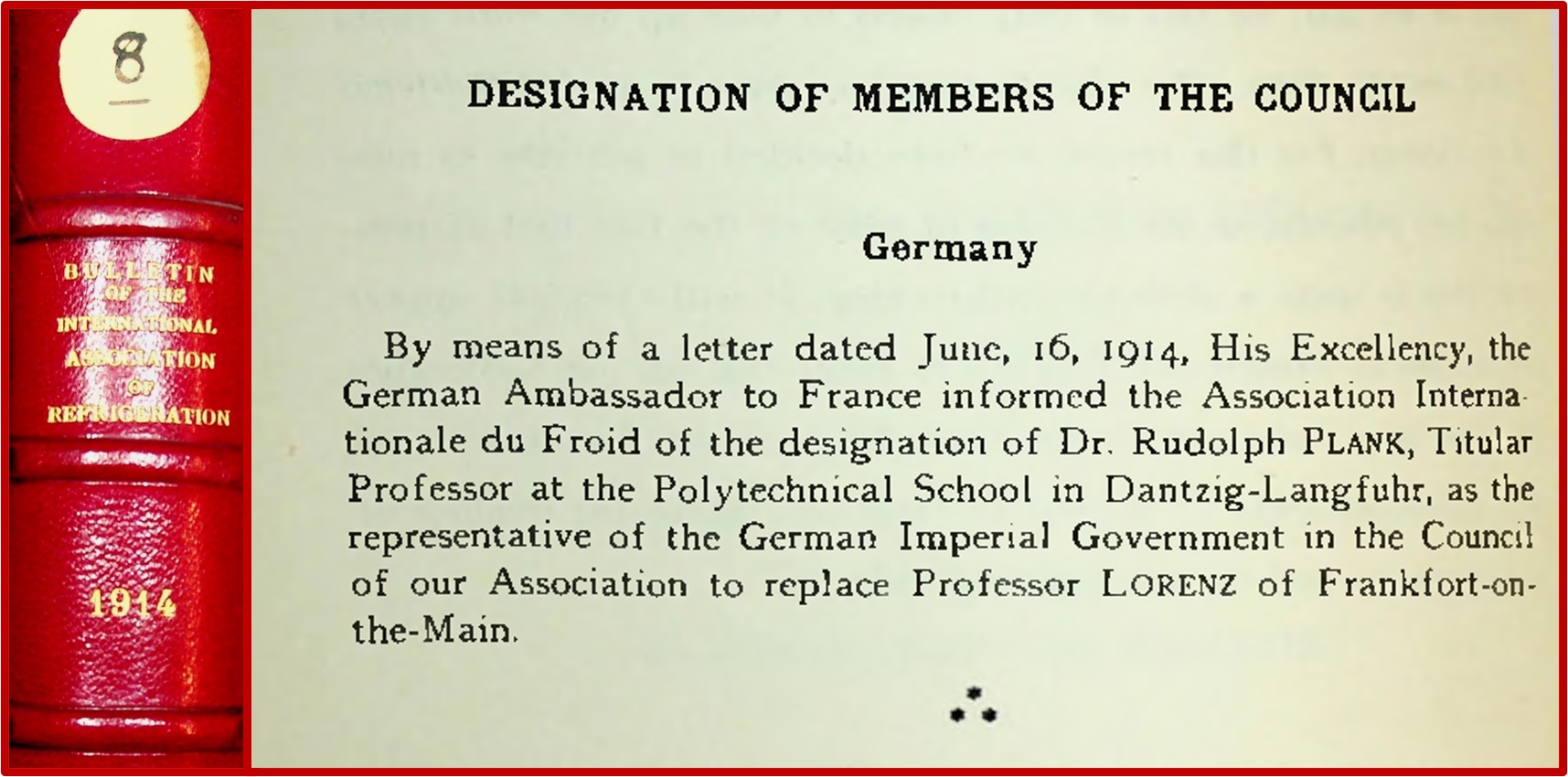
In June 1914, at just 28 years of age, Aloys Valerian Rudolf Plank was appointed representative of the German Imperial Government to the Council of the young International Association of Refrigeration, founded only five years earlier. Three months later, the First World War broke out. Despite the upheavals that would shape Europe over the following decades, Plank remained faithful to the ideal of scientific cooperation championed by the Institute.
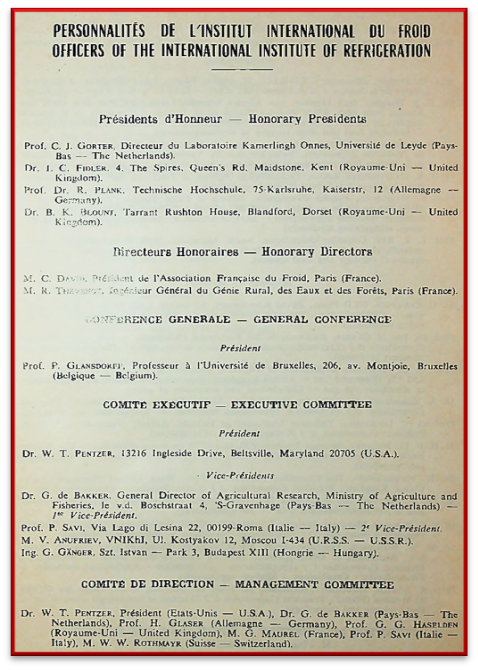
Fifty-five years after his first appointment, in October 1969, having occupied nearly every senior position within the IIR, he attended the Executive Committee meetings for the last time before retiring. The man whom his contemporaries described as “the world's best-known refrigeration specialist” passed away four years later at the age of 87.
Early Scientific and Technical Contributions
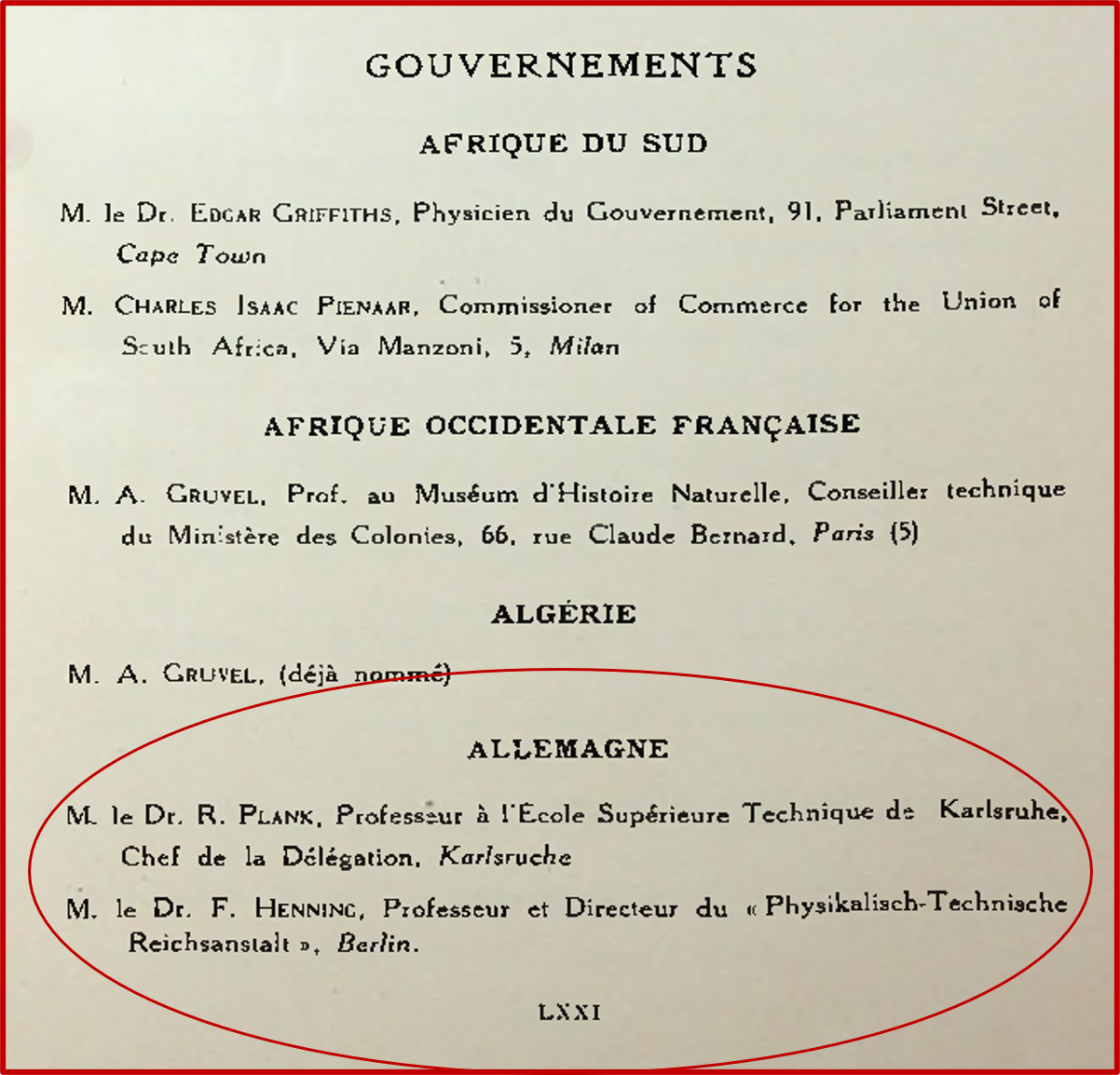
Following the First World War, Rudolf Plank resumed his active participation in international refrigeration activities. He attended the London Congress in 1924 and led the German delegation at the Rome Congress in 1928.
His commitment was quickly recognised. In 1930, he was appointed Vice-President of the International Commission on Refrigerating Machinery. Even when unable to attend Institute events in person, he continued to contribute to its work. At the Buenos Aires Congress in 1932, for example, he presented two significant papers, one on the thermodynamic properties of fluids and the other on the rapid freezing of food productsA, B. These studies already reflected the two major themes that would define his career: thermodynamics and food preservation.
At the same time, Plank undertook numerous missions around the world. He travelled to China to study fish-freezing facilities using the Ottesen process, visited Japan, Manchuria, Argentina, Uruguay and Brazil to observe food preservation techniques, and was sent to South Africa to study and supervise the first pre-cooling installations.
|
|
 |
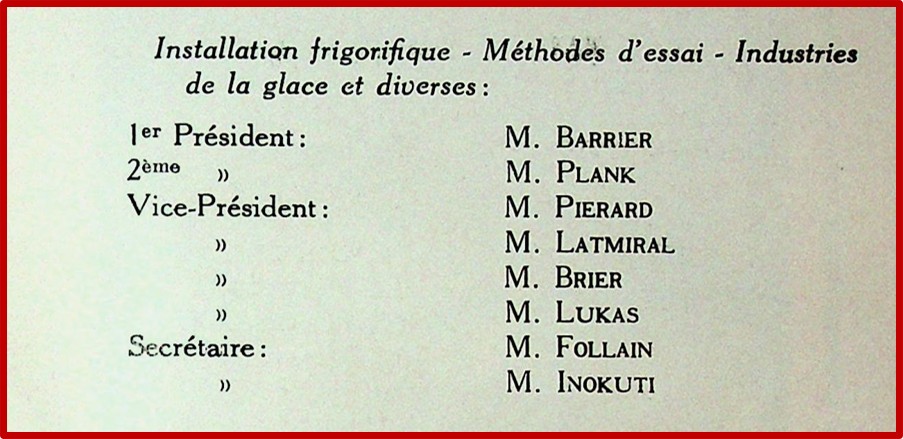 |
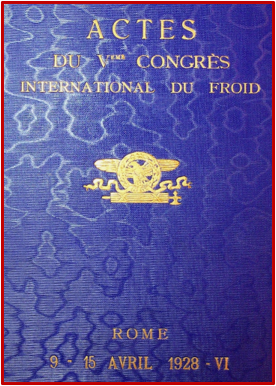
Scans: Proceedings of IIR International Congresses of Refrigeration.
Karlsruhe: The Work of a Lifetime
The year 1926 marked a decisive turning point in his career with the creation of the Refrigeration Engineering Institute at the Karlsruhe Institute of Technology. This achievement was probably the accomplishment of which he was most proud and the one that brought him lasting international recognition.
He gradually expanded the institute by establishing a research centre dedicated to food preservation in 1936. Under his leadership, Karlsruhe rapidly became one of the world's leading centres for refrigeration research and education. Several of his students, including Johann Kuprianoff and Kurt Nesselmann, would in turn contribute to the international reputation of the school.
A Humanist Dedicated to International Cooperation
The year 1937 marked another important milestone in his IIR career. Under the impetus of the American delegate Gardner Pool, the Institute created a Technical Board, which would later become today's Science and Technology Council (STC). Rudolf Plank was appointed Vice-President while retaining his responsibilities within the Commission on Refrigerating Machinery.
The same period saw preparations for the 8th International Congress of Refrigeration, scheduled to take place in Baden-Baden in 1940. Plank played a major role in its organisation. However, the outbreak of the Second World War abruptly ended these plans.
The war also destroyed a large part of his life's work. The Karlsruhe Institute of Technology, of which he was then Rector, suffered severe damage. Refusing to give in to discouragement, he immediately undertook its reconstruction, together with that of the food preservation research centre. Thanks to his energy and the support of former students who had become faculty members, Karlsruhe quickly regained its international standing.
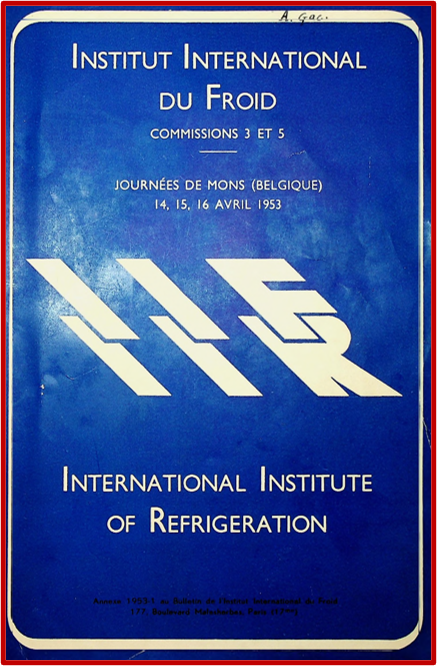 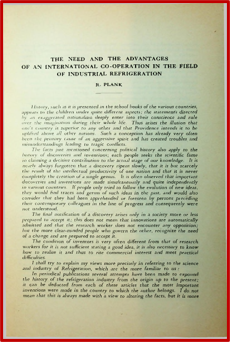 |
Scan: International Institute of Refrigeration, Commissions 3 and 5, Mons Days (Belgium), 14–16 April 1953.
His determination to preserve scientific ties despite international crises is clearly reflected in the opening address he delivered at the Mons Days in 1953, entitled “The Need for and Advantages of International Cooperation in Industrial Refrigeration.” In a context dominated by Cold War tensions, he declared:
“The differences in political forms of Governments do not imply any differences in the scientific and technical problems to be solved.”
For Plank, science had to remain a field of dialogue between nations, regardless of political divisions.
The same conference also revealed his deep attachment to the refrigeration sector, which he viewed as uniquely suited to continually pushing back the boundaries of knowledge and technology. This admiration was accompanied by a touch of good-natured scepticism towards other specialities that, in his view, seemed to have found their comfort zone and decided to remain there.
“This profession obliges us to go beyond the limits imposed on the activities of most of the engineers and to escape into the boundless spaces of the applications of low temperatures. The diversity of these applications enlarges our horizons and prevents us from degenerating to narrow-minded specialists of a type so frequently met among professionals.”
Years of International Recognition
At the Paris Congress in 1955, Rudolf Plank delivered a keynote lecture devoted to the first hundred years of mechanical refrigeration. Reviewing the history of refrigeration from William Cullen's experiments to the industrial expansion of the nineteenth century, he concluded that the industry was still young and possessed immense potential for future development. A statement that has certainly been borne out by the subsequent growth of the sectorC. That same year, he was elected Vice-President of the IIR Executive Committee.
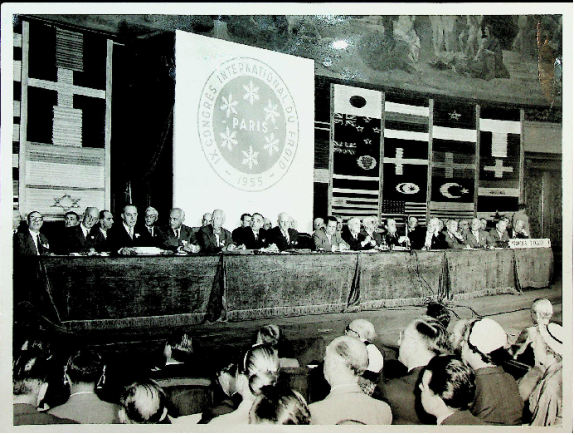
Four years later, at the Copenhagen Congress in 1959, he became President of the General Conference, making him the most influential figure within the Institute. The appointment was a fitting tribute to a man who was, by then, recognised as one of the world's leading figures in refrigeration.
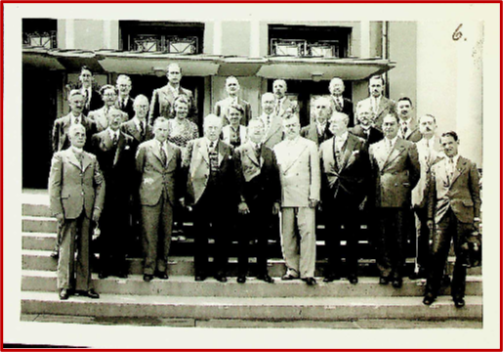
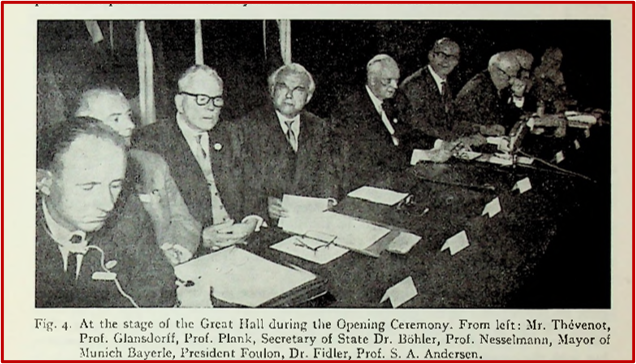
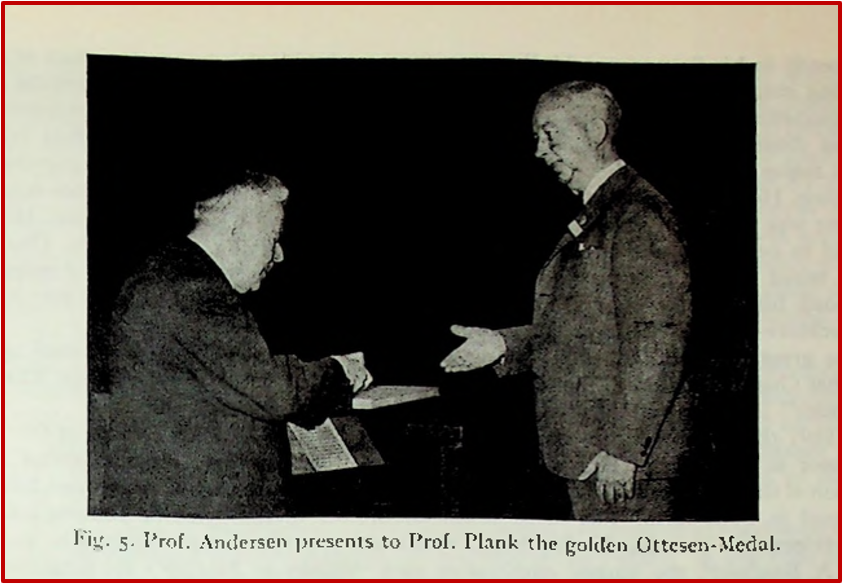
In 1963, during the first Congress finally held in Germany, in Munich, he received the prestigious Ottesen Medal awarded by the Danish Refrigeration Association. In accordance with the Institute's statutes limiting consecutive mandates, he subsequently handed over the presidency of the General Conference to his friend and former student Johann Kuprianoff.
A Lasting Legacy
Rudolf Plank continued to represent West Germany on the Executive Committee until 1969. Upon his death, Michel Anquez, then Director of the Institute, wrote:
“Today; the International Institute of Refrigeration grieves the loss of one of its last pioneers who developed and popularised, since the beginning of the century, the science and techniques of refrigeration. Great as this loss may be, the IIR is nevertheless proud and privileged to have had such an eminent person in its circle of faithful members. His memory will forever remain as a model for all of those who, today, throughout the world, are endeavouring to plough the furrow which he traced out for us.”
More than half a century after his death, his influence remains very much alive. In 2025, at the first IIR Adaptation Conference, a team of Italian researchers presented a study devoted to the transcritical CO₂ cycle originally proposed by Plank, one of many signs that his work continues to inspire contemporary research.
A visionary scientist, institutional builder and tireless advocate of international cooperation, Rudolf Plank remains one of the founding figures in the history of the International Institute of Refrigeration. His legacy continues to shape the identity and development of the IIR today.
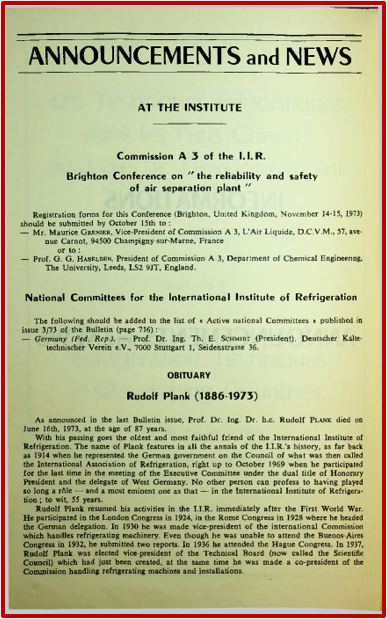
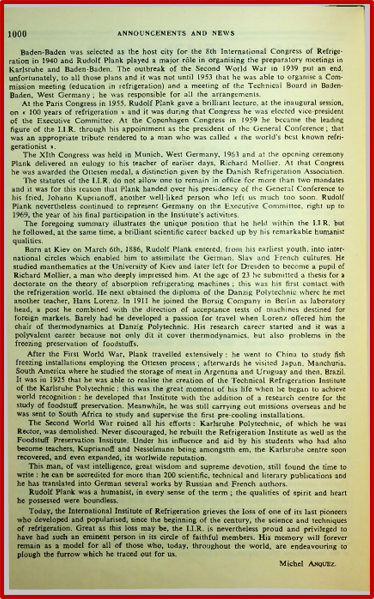
Posthumous tribute to Professor Plank in the 1973 IIR Bulletin.
A Plank R. On the law of a straight-line diameter for the viscosities of liquids and saturated vapours. Proceedings of the 6th International Congress of Refrigeration: Buenos Aires, Argentina, August 24-September 15, 1932.
B Plank R., Kuprianoff J. and Peters. —Rapid freezing of foodstuffs by direct contact with refrigerating agents undergoing evaporation. Proceedings of the 6th International Congress of Refrigeration: Buenos Aires, Argentina, August 24-September 15, 1932.