
 Share
ShareLooking back on 2025: Focus on the new Parties to the Kigali Amendment
As 2025 closed, 9 new countries have become parties to the Kigali Amendment in 2025, now binding for 171 countries across the world, setting an auspicious environment for the amendment to match the success of the Montreal Protocol.
The new Contracting Parties to the amendment are Nepal, the island state of Saint Kitts and Nevis, Brunei Darussalam, Saudi Arabia, the Central African Republic, Pakistan, Azerbaijan, Mauritania, and Malta.
While representing singular circumstances, timelines, and pathways to reach its objectives, each new party takes part in the global effort to phase down hydrofluorocarbons (HFCs) and reduce greenhouse gas emissions.
Phase-out schedules
While some’s freeze date preceded the accession to the amendment, their compliance schedules remain unaffected by this timing.
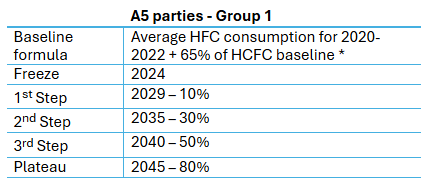
Eight of them are listed as Article 5 countries, with Pakistan and Saudi Arabia belonging to Group 2 which has a delayed start for the phase down of HFC as defined by Decision XXVIII/2.
The HFC freeze for Azerbaijan, Brunei, Central African Republic, Mauritania, Nepal, and Saint Kitts and Nevis, is set for 2024 and will follow the Kigali schedule set to be:
As for Saudi Arabia and Pakistan, they follow the delayed schedule for Group 2:
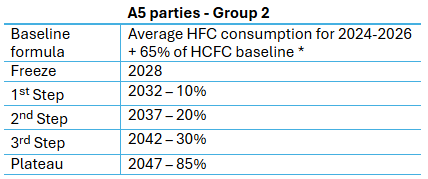
* Where countries lack the needed HFC data on consumption and production for their respective baseline years, the share of the total HCFC baseline in CO2eq may be used to estimate total HFC consumption. Saudi Arabia, along other large HCFC-consuming countries, has used this HCFC proxy method to estimate its HFC consumption [1].
As a non-article 5 country, Malta will have to cut its HFC consumption by 85% by 2036. It has been reporting data through the European Union in an aggregated form, which has shown to be well on track in the past years.
High-Ambient-Temperature exemption
Pakistan, Saudi Arabia, Central African Republic, and Mauritania are further listed as high-ambient-temperature (HAT) countries, allowing them an extension where suitable alternatives do not exist for a specific subsector of use, should they request so.
The list of exempted equipment laid in Appendix I, includes: (a) Multi-split air conditioners (commercial and residential); (b) Split ducted air conditioners (commercial and residential); (c) Ducted commercial packaged (self-contained) air-conditioners.
This exemption allows for a delay in the HFC freeze date and initial control obligations by an initial duration of four years. Countries operating under the HAT exemption have until 2026 to ask for a deferral of up to 2 extra years then (or 4 years from the freeze date of 2024).
As of the end of 2025, no country has effectively made complete use of the exemption.
Read more about our MOP37 side event “Strengthening cold chain technologies in hot climates”
Energy efficiency and MEPS
Transitioning to low-GWP refrigerants also needs to be accompanied with adequate energy efficiency policies to further avoid CO2 emissions and encourage the replacement of inefficient technologies. Several of the new Kigali parties have already taken steps toward the uptake of energy efficient appliances through standardisation, notably minimum energy performance standards (MEPS).
Saint Kitts and Nevis is applying the regional standards issued from CARICOM Regional Energy Efficiency Building Code (CREEBC) since 2018, participating in the harmonisation of the region.
Azerbaijan adopted 4 national standards on Refrigeration, Air Conditioning and Heat Pump (RACHP) appliances’ systems in April 2025 (AZS EN 12102-1:2025, AZS EN 12900:2025, AZS IEC 62552-1:2025, AZS EN 14511-3:2025) while further national energy efficiency standards based on ISO standards are being discussed by the Technical Committee on Standardization.
Pakistan, through the Pakistan Standards & Quality Control Authority (PSQCA), has published MEPS and labelling requirements for room air conditioner (PS 5294:2021) and for refrigerating appliances (PS 5531:2021).
In 2025, Saudi Arabia has updated its MEPS for refrigerators and freezers (SASO 2892:2025), for low-capacity air-conditioners (SASO 2663:2025) and large-capacity air conditioners (SASO 2874:2025), through the Saudi Standards, Metrology and Quality Organization (SASO).
Looking ahead
At a time when international cooperation to face the environmental crisis is needed, these elements of progress across countries show promise. The sustainable transition of the RACHP sector and the reduction of greenhouse gas emissions in the context of the Kigali Amendment demonstrate that differentiated but steady and compliant national pathways around the world can still move together toward a safer and more sustainable future.
Source
[1] CCAC. A Study on the Impacts of HFC Consumption Trends in Article 5 Countries. June 2022. https://www.ccacoalition.org/sites/default/files/resources//FINAL%20HFC%20CONSUMPTION%20TRENDS-corrected%20Aug2022.pdf