
 Share
ShareScientists show how noise can drive refrigeration in quantum circuits
A team of researchers from the Chalmers University of Technology in Gothenburg, Sweden, has experimentally tested a superconducting device which uses dephasing noise to power cooling at the quantum scale
Cooling challenges from classical refrigeration to quantum systems
Cooling is fundamental in both classical and quantum technologies. In the refrigeration world, systems like vapor-compression or absorption refrigerators transfer heat from a lower-temperature source to a higher-temperature sink using mechanical work or thermal gradients. In quantum systems, especially superconducting quantum processors, cooling is not just a convenience: it is essential. Quantum bits (qubits) only behave as intended when thermal disturbances are extremely low, often requiring temperatures near absolute zero. But refrigerating such systems is difficult and energy intensive. Conventional refrigeration methods struggle to remove heat that is generated inside quantum circuits themselves.
Within this context, a team of researchers from the Department of Microtechnology and Nanoscience of the Chalmers University of Technology in Gothenburg, Sweden, have demonstrated a novel type of quantum refrigerator that turns a traditional nuisance in quantum electronics, dephasing noise, into a useful resource for cooling. Published in Nature Communications [1], the work shows how engineered noise can drive heat transport in a superconducting circuit, effectively cooling one part of the system at the expense of another in a controlled way.
A noise-driven quantum refrigerator based on superconducting circuits
The Chalmers University of Technology team realized a microscopic artificial diatomic molecule using flux-tunable transmon qubits, tiny superconducting elements that act like discrete quantum energy levels. These are coupled to two microwave waveguides which act as a high-temperature and a low-temperature reservoirs, where the temperature is controlled by injecting spectrally localized, calibrated noise. Energy transfer between the reservoirs proceeds via noise-assisted excitation transport through the molecule, realized by injecting controlled dephasing noise on one of the atoms composing the artificial molecule.
In operation, controlled noise induces transitions between quantum states of the artificial molecule. By tuning the relative temperatures of the reservoirs and the noise properties, the device presented by the researchers can exhibit three distinct behaviours: acting as a refrigerator (extracting heat from a cold reservoir), as a heat engine (generating a net heat flow from hot to cold), or as a thermal accelerator. It is worth noting that “hot” and “cold” labels are used to distinguish the two different temperature levels in the system: on an absolute scale, the temperature levels set during the experiments are both in the range of approximately 0.1 K. Heat flows were measured during the experiments at extremely small scales (attowatts, 10-18 W), confirming steady-state refrigeration under the right conditions.
New opportunities for heat control in quantum electronics
The experiments documented in this relevant research paper represent a meaningful proof-of-principle experiment proving that dephasing noise, normally minimized or filtered out, can be repurposed as the power source of a quantum thermal machine, representing an additional and innovative option on how heat can be managed in quantum electronics. Instead of applying external work or temperature gradients in the classical sense, the device presented by the researchers uses randomness itself to transport heat directionally at the quantum level. This opens up new ways to manage heat in cryogenic and quantum computing environments, potentially supplementing or enhancing existing refrigeration techniques that dominate today’s quantum hardware cooling.
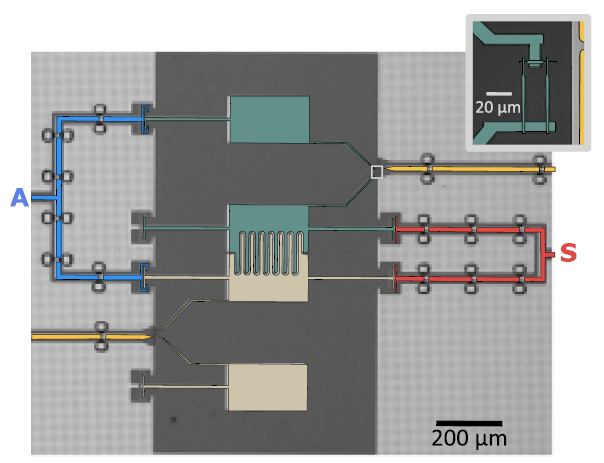
For more information, the scientific paper is available in open access in Nature Communications.
Sources:
[1] Sundelin, S., Aamir, M.A., Kulkarni, V.M., Castillo-Moreno, C., Gasparinetti, S. (2026). Quantum refrigeration powered by noise in a superconducting circuit. Nature Communications 17, 359 (2026). https://doi.org/10.1038/s41467-025-67751-z
Image credits: Simon Sundelin/Chalmers University of Technology in Gothenburg, Sweden.