
 Share
ShareSensing technologies and AI could transform frozen seafood quality monitoring
A recent review paper by a team of researchers from Jiangsu University, China, examines how advances in non-destructive sensing and artificial intelligence could enable faster and more comprehensive quality assessment of frozen seafood throughout the cold chain.
New tools for monitoring frozen seafood quality
A recent review paper [1] published in Foods by a team of researchers from Jiangsu University, China, examines recent advances in sensing technologies and artificial intelligence (AI) for assessing the quality of frozen seafood. Freezing is essential for extending seafood shelf life and enabling its global distribution, but it cannot completely prevent quality deterioration during storage and transport.
During frozen storage, frozen seafood can undergo interconnected physicochemical changes including ice crystal growth, water redistribution, protein denaturation and oxidation, lipid oxidation, texture deterioration and flavour and colour changes. Conventional assessment methods, including laboratory analyses and sensory evaluation, are still widely used, but can be destructive, labour-intensive and too slow for rapid or real-time cold-chain monitoring.
The review highlights the growing potential of non-destructive sensing technologies, including near-infrared and Raman spectroscopy, hyperspectral and fluorescence imaging, low-field nuclear magnetic resonance, electronic noses and tongues, colorimetric sensor arrays and biosensors. Combined with machine learning and deep learning, these technologies can analyse complex data to evaluate characteristics such as freshness, spoilage, oxidation, water-holding capacity and shelf life without damaging the product.
Intelligent quality monitoring throughout the cold chain
According to the authors, combining information from multiple sensors with AI could provide a more comprehensive picture of seafood quality than relying on single quality measurements and indicators. However, several barriers still need to be addressed before widespread commercial deployment, including the need for larger and more diverse datasets, reliable performance across different seafood species and operating conditions, standardised validation methods, and more affordable and portable sensing equipment.
Looking ahead, the review paper identifies the integration of sensing technologies with AI, Internet of Things (IoT) connectivity, cloud computing and digital traceability systems as a promising pathway towards continuous, real-time quality monitoring throughout the seafood cold chain. Such systems could support better shelf-life management and earlier identification of quality deterioration, ultimately helping to reduce food waste, improve food safety and strengthen product traceability.
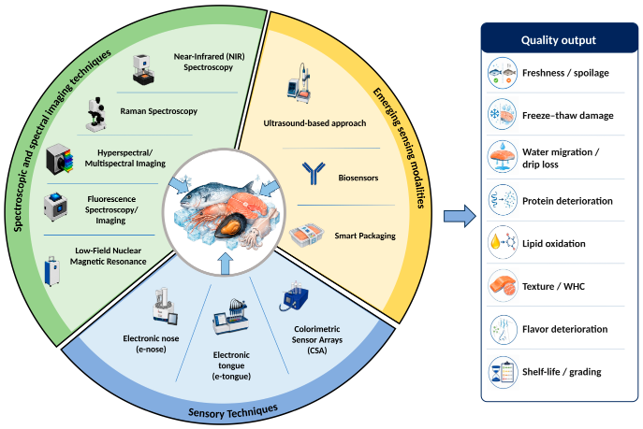
Figure. Non-destructive sensing technologies, used for frozen seafood quality assessment, reviewed in [1].
For more information, the review paper is available in open access in Foods.
Cold Chain Technology Brief: Fishing Vessel Applications
Recommendations for the Processing and Handling of Frozen Foods
Recommendations for Chilled Storage of Perishable Products
[COMING SOON]
Sources:
[1] Mohamed, M. T. O., Nunekpeku, X., Prempeh, N. Y. A., Jiang, W., & Li, H. (2026). Quality Assessment in Frozen Seafood: Advances in Sensing Technologies and Artificial Intelligence. Foods, 15(16), 2799. https://doi.org/10.3390/foods15162799