
 Share
ShareA new study explores affordable pathways to sustainable diets with lower cold chain climate impact
A research paper presented at the 9th IIR Conference on Sustainability and the Cold Chain (ICCC 2026) by a team of authors including three members of the IIR Science and Technology Council (STC) examines how nutritionally balanced, affordable diets can support climate mitigation while influencing future food cold chains.
Balancing emissions, nutrition and affordability
Presented at the 9th IIR Conference on Sustainability and the Cold Chain (ICCC 2026), held on 12–14 April 2026 in Istanbul, Türkiye, a new study by a multidisciplinary research team including Prof. Judith Evans, President of IIR Section C – Biology and Food Technology, Dr. Alan Foster, member of IIR Commission D1 – Refrigerated Storage, and Dr. Xinfang Wang, member of IIR Commission E2 – Heat Pumps and Energy Recovery, explores how sustainable dietary transitions can simultaneously reduce greenhouse gas emissions, remain nutritionally adequate, and become more affordable for consumers [1].
The research develops a hybrid modelling framework that combines system dynamics and optimisation techniques to investigate how gradual reductions in meat consumption in the United Kingdom could be accompanied by nutritionally adequate and economically accessible alternatives. By incorporating food prices alongside nutritional and greenhouse gas (GHG) data, the model identifies dietary transition pathways that simultaneously reduce emissions, maintain nutritional quality and improve affordability across different income groups.
In particular, the researchers found that considering food prices alongside greenhouse gas emissions in the optimisation strategy can lead to much more affordable dietary transitions. By 2030, the additional cost of plant-based substitutions is around 40–45% lower than under an emissions-only optimisation, while achieving nearly the same reductions in dietary greenhouse gas emissions. The results suggest that sustainable diets can be both environmentally effective and economically accessible when affordability is integrated into dietary planning.
Implications for policy and the cold chain
The study concludes that sustainable dietary transitions should be evaluated through multiple dimensions rather than emissions alone. Policies that jointly consider nutrition, affordability and environmental performance are more likely to support widespread adoption of lower-carbon diets and ensure equitable outcomes across society. The proposed framework provides an adaptable tool for exploring realistic transition pathways and informing evidence-based food and climate policies.
Beyond dietary change itself, the authors note that shifts in food consumption could also influence refrigeration demand and cold-chain operations, as different food categories have distinct storage and distribution requirements. The paper therefore highlights the importance of future research linking sustainable diet modelling with food logistics and cold-chain energy analysis, supporting a more integrated understanding of how food system transitions can contribute to climate mitigation.
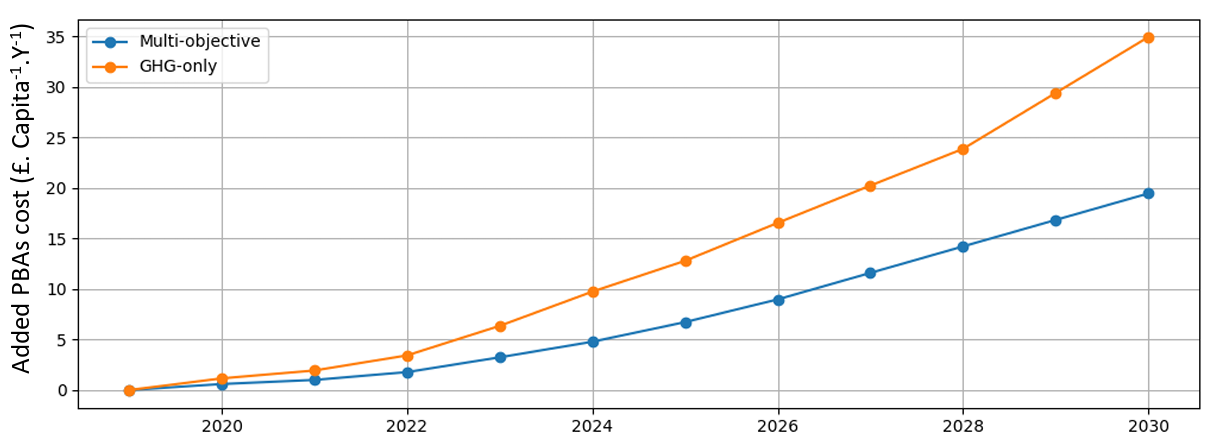
Figure. Annual per-capita increase in dietary cost due to added plant-based alternatives to meat under two optimisation scenarios: GHG emissions-only optimisation (in orange) and combined GHG emissions and costs optimisation (in blue). [1]
For more information, the research paper is available in FRIDOC.
Source:
[1] Naseh-Moghanlou, L., Evans, J., Foster, A., Wang, X. (2026). Modelling the cost–nutrition–emission trade-offs in the UK’s transition to sustainable diets. 9th IIR International Conference on Sustainability and the Cold Chain. Proceedings: April 12-14 2026. http://dx.doi.org/10.18462/iir.iccc.2026.8383