
 Share
ShareICCC2026: Mapping of Rwanda’s refrigeration emissions compared with UK’s emissions
The UK has 14 times higher per capita emissions than Rwanda (262 compared to 19 kgCO₂e), according to estimates by Dr Alan Foster and colleagues presented at the 9th IIR International Conference on Sustainability and the Cold Chain (ICCC). As Rwanda continues to develop and its demand for refrigeration increases, it is important to ensure that the country's refrigeration sector expands sustainably.
According to Rwanda’s National Cooling Strategy published in 2019, the country had an estimated stock of about 75,000 refrigerators and 50,000 air conditioners. With rising economic development, populationgrowth and the need for adaption measures to climate change, the cooling demand is expected to grow significantly along with associated GHG emissions.
During the 9th edition the IIR International Conference on Sustainability and the Cold Chain (ICCC), IIR D1 commission member Dr Alan Foster and colleagues Dr. Henrique Lagoeiro, Dr. Catarina Marques and Prof.Judith Evans, from London South Bank University, UK, presented a paper modelling GHG emissions for the refrigeration sector in Rwanda, in comparison with available date from the UK.
Comparative mapping of refrigeration related GHG emissions in Rwanda and the UK
The authors estimated that in 2020, Rwanda had a per capita electrical consumption from refrigeration of 13.5 kWh/a compared to the UK consumption of 416 kWh/a.
Figure1 illustrates the energy consumption, with values for Rwanda specified in GWh and UK values in TWh due to the magnitude difference between the countries. Apart from the difference in scale of the emissions, the other large difference is that in Rwanda, 67% electrical demand is from stationary air conditioning, whereas in the UK it is only 17%. In addition, 57% of the energy demand comes from household refrigeration in the UK, compared with only 23% in Rwanda.
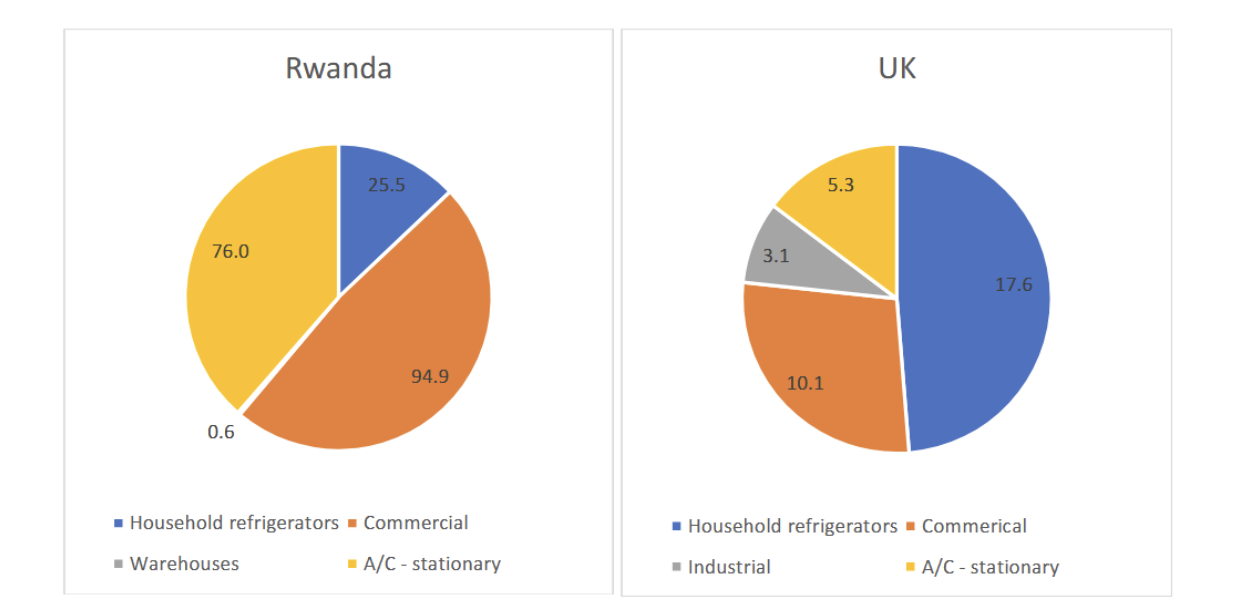
Figure1. Energy consumption of refrigeration sectors in UK (TWh) and Rwanda (GWh)
Overall, the total refrigeration GHG emissions for Rwanda and the UK were estimated at 274 and 18,195 ktCO2e respectively. The UK has 14 times the per capita emissions than Rwanda (262 compared to 19 kgCO2e). Figure 2 shows the emissions for the different scopes for Rwanda and UK.
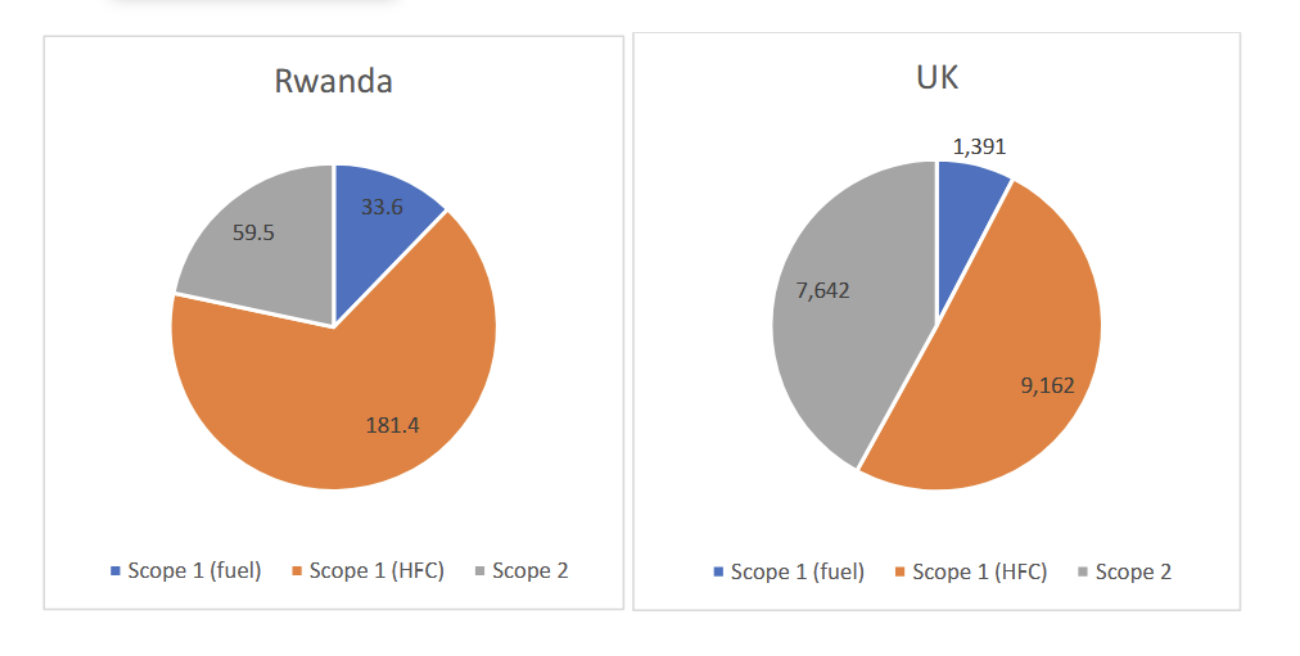
Figure 2. Total Scope emissions for the UK and Rwanda (ktCO2e).
Disclaimer from the authors: Caution should be exercised in extrapolating the conclusions regarding air conditioning to all developing countries near the equator. Rwanda is at high altitude (average around 1600 metres). This makes the need for air-conditioning much less than in countries such as those in West and North Africa or in South Asia.
Outlook for a sustainable refrigeration sector in Rwanda
Rwanda’s commitment to sustainable cooling is reflected by the ongoing implementation of the HCFC Phase-Out Management Plan (HPMP) and the initial phase of the Kigali Implementation Plan (KIP). This hasgiven way to key actions such as the nationwide training of refrigeration and air-conditioning technicians on the safe handling, and recovery of refrigerants, as well as the promotion of low-GWP alternatives.
As Rwanda develops and its refrigeration demand increases, it is important to ensure that the country’s refrigeration sector expands sustainably, in order to curb the growth in related GHG emissions.
Natural Refrigerants in Africa
Sources
[1] Republic of Rwanda. Ministry of Environment (2019). National Cooling Strategy. https://www.rema.gov.rw/fileadmin/templates/Documents/National_Cooling_System_book_-_Print__1_.pdf
[2] Foster A., Lagoeiro H., Marques C., Evans J. Refrigeration and air conditioning emissions in a developing country (Rwanda)compared to a developed country (UK). 9th IIR International Conference on Sustainability and the Cold Chain. Proceedings: April 12-14 2026. http://dx.doi.org/10.18462/iir.iccc.2026.8203
[3] UNEP (2025). https://ozone.unep.org/sites/default/files/additional-reported-information/decisionXXXVI2/Rwanda.pdf