
 Share
ShareIEA Report: Air-conditioning and desalination to drive half of peak electricity demand in MENA
Due to rising temperatures and water scarcity exacerbated by climate change, IEA predicts that electricity demand in the MENA region will rise by 50% by 2035, driven mainly by air-conditioning and desalination.
In September 2025, the International Energy Agency (IEA) released The Future of Electricity in the Middle East and North Africa report, which examines the progression of electricity demand in the Middle East and North Africa (MENA) region in the coming decade.
In a region where summer temperatures regularly exceed 40 °C, rising temperatures and extreme weather events due to climate change directly affect air-conditioning demand.
According to IEA, air conditioning currently accounts for approximately half of peak demand in the MENA region and is projected to maintain a similar share out to 2035. With increasing temperatures, a rise in air conditioners (AC) ownership partially explains this trend. While 80% of households in the Gulf Cooperation Council Member countries already own an AC, the regional average currently stands at 27% [1] (see figure). The IEA points out that improving energy efficiency should help offset the growth in energy demand.
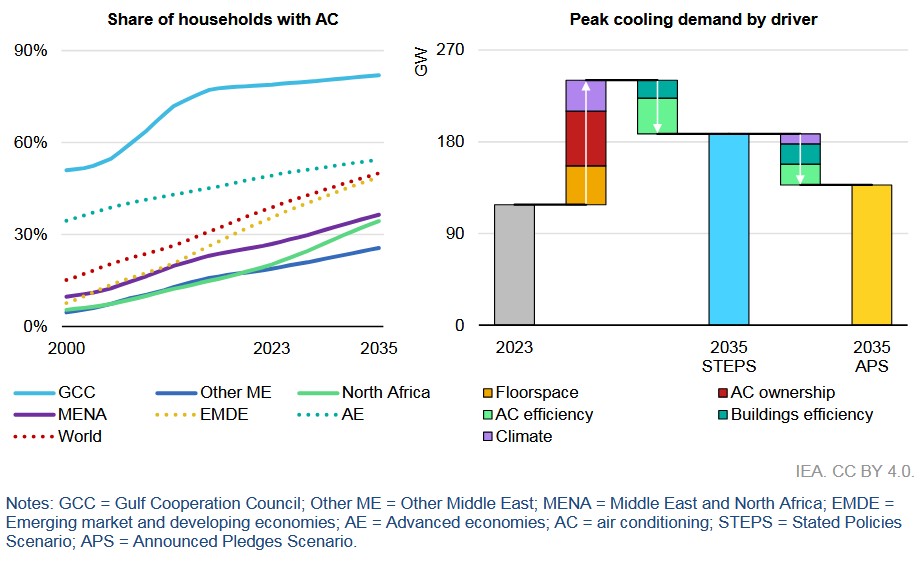
Climate change also exacerbates droughts and overall water scarcity, depleting agricultural productivity, and increasing reliance on exports [2] and therefore refrigeration demand for the cold chain. Diminished water availability also hinders the refrigeration processes of thermal power plants, further exacerbating energy supply challenges in some MENA countries [2].
As one of the driest regions globally, MENA receives only 2 % of the world's renewable water supply despite hosting 6 % of the global population [2]. According to IEA, water desalination capacity across the MENA region is expected to quadruple over the next decade [1]. The resulting pressure on energy demand is expected to be offset by the recent adoption of energy-efficient electricity-powered membrane technologies, replacing historical thermal desalination technologies relying on fossil fuels.
The complete report is available in open access on the IEA website.
Sources
[1] IEA (2025), The Future of Electricity in the Middle East and North Africa, IEA, Paris https://www.iea.org/reports/the-future-of-electricity-in-the-middle-east-and-north-africa , Licence: CC BY 4.0
[2] Qasem, R. H. M., & Scholz, M. (2025). Climate change impact on resources in the MENA region: a systematic and critical review. Physics and Chemistry of the Earth, Parts A/B/C, 103936. https://doi.org/10.1016/j.pce.2025.103936