
 Share
ShareIIR Highlights from the OEWG-47 Side Event: Empowering Women in the Cooling Sector
The International Institute of Refrigeration participated in a side event organised by GIZ Proklima, focused on advancing gender equality in the refrigeration, air conditioning and heat pumps (RACHP) sector.
At the margins of the 47th Open-Ended Working Group (OEWG 47) meeting under the Montreal Protocol, the International Institute of Refrigeration participated in a dynamic and thought-provoking side event organised by GIZ Proklima, focused on advancing gender equality in the refrigeration, air conditioning and heat pumps (RACHP) sector.
With over 12 million people employed globally in the RACHP industry and demand continuing to grow, the sector faces a critical shortage of skilled labor [1]. Yet, women remain severely underrepresented, accounting for only 6% of members in national RACHP organisations, according to IIR [2].
A Global Dialogue on Barriers and Solutions
The event opened with remarks from Sebastian Schnatz of the German Federal Ministry for the Environment, Climate Action, Nature Conservation, and Nuclear Safety (BMUKN), followed by a presentation of key data and insights by Souhir Al Hammami, Director of Scientific and Technical Information at the IIR. Her intervention highlighted the structural and cultural barriers that continue to limit women’s participation in the sector.
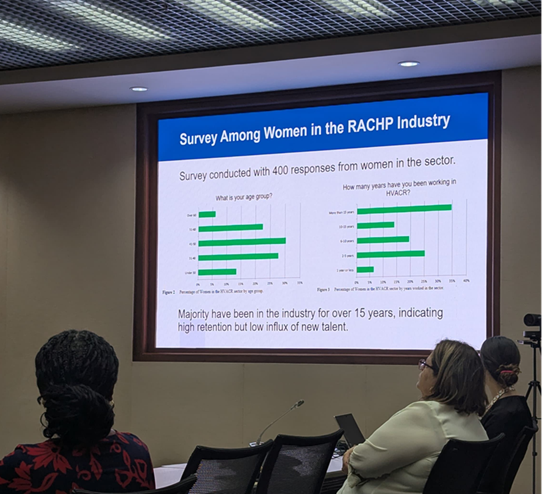
A short video titled Women’s Voices added a personal dimension to the discussion, sharing real-life experiences of women working in the field.
Participants then engaged in interactive group discussions centered around four key stages of a woman’s career path in the cooling sector:
- Career Choice Stage
- Education and Training
- Career Entry
- Daily Work and Career Progression
Key Challenges Identified
Participants from Grenada, Bhutan, China, the Philippines, Nigeria, Germany, and Mauritius shared diverse regional perspectives. Despite differences in context, several common challenges emerged:
- Cultural and societal norms that discourage women from pursuing technical or “hand-based” careers.
- Lack of visibility of the RACHP sector as a viable and rewarding career path.
- Limited access to education and training, particularly in rural or underserved areas.
- Scarcity of female role models and mentors in the field.
- Workplace environments that are not always inclusive or adapted to women’s needs.
In China, the number of women entering the sector is growing, possibly influenced by the one-child policy and a national emphasis on STEM education. In Bhutan, improved access to education is gradually opening doors for girls, though cultural and family expectations remain significant barriers.
Pathways Forward
The event emphasised the importance of:
- Awareness campaigns to promote the sector and challenge gender stereotypes.
- Inclusive training programs that actively recruit and support women.
- Policy support and collaboration with ministries to create enabling environments.
- Curriculum development to include refrigeration-specific courses in technical education.
The session concluded with a presentation of recommendations from the Green Cooling Initiative (GCI) and closing remarks by Guntram Glasbrenner of GIZ Proklima.
The IIR reaffirms its commitment to promoting diversity, equity, and inclusion in the refrigeration sector. This side event was a valuable opportunity to identify barriers, share experiences, and co-develop solutions. With only 6% female representation [2], the sector must act decisively to become more inclusive, sustainable, and representative of the global talent pool.
Sources
[1] Baha M., Hammami S., Dupont J.-L. The Role of Refrigeration in the Global Economy. 3rd edition. 60th Technical Brief on Refrigeration Technologies. International Institute of Refrigeration (IIR), Paris. http://dx.doi.org/10.18462/iir.TechBrief.04.2025
[2] I. Colombo, C. Marques, J. Evans, M. Kauffeld, G. Tarlea and S. Fournier. Women in the Cold Chain Industry. 4th IIR International Conference on Sustainability and the Cold Chain. Proceedings: Auckland, New Zealand, 7-9 April 2016. http://dx.doi.org/10.18462/iir.iccc.2016.0003