
 Share
Share2025 AFCE report highlights HFC emission trends and France’s transition toward low-GWP refrigerants
According to the AFCE/Citepa report, France’s HFC emissions have been steadily decreasing since 2018, and accounted for only 2.3% of France’s total greenhouse gas emissions in 2023.
Every year, the French association AFCE (“Refrigeration, Air-Conditioning and Environment Alliance”) publishes its Refrigerants report on the residential refrigeration, air conditioning and heat pump sector. The report uses the annual inventory conducted by Citepa, a French association supporting the environmental transition and climate action, to assess France’s greenhouse gas (GHG) emissions under the country’s commitments to the Kyoto Protocol and the Paris Agreement.
According to the 2025 report, which presents data from 2023, HFC emissions accounted for only 2.3% of France’s total GHG emissions (Figure 1) [1]. Most of these fluorinated gas emissions (84%) were attributed to refrigeration and air conditioning applications (Figure 2).
For comparison, in 2022, fluorinated gases represented 2% of total GHG emissions in the EU-27 [2].
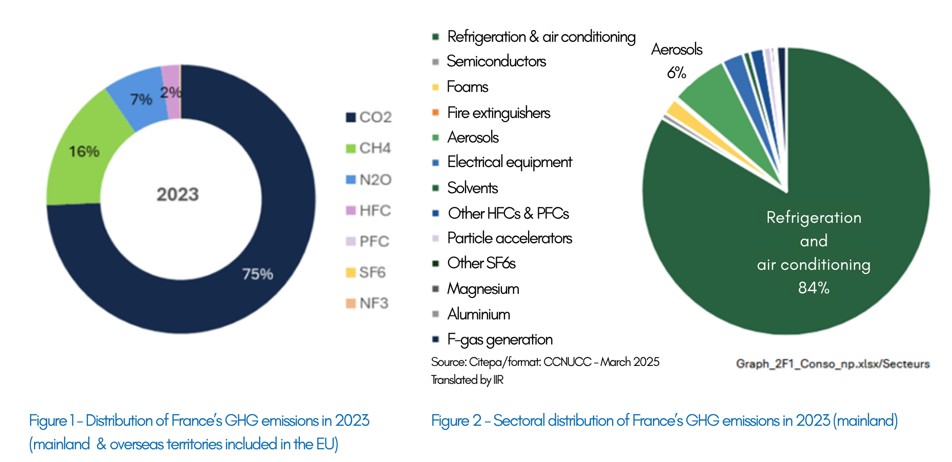
Despite a steady increase in the total bank of refrigerants contained in air-to-air air conditioners (+5.4% per year on average between 2018 and 2023) and air-to-water or water-to-water heat pumps (+11.8% on average over the past 3 years), refrigerant emissions are decreasing [1].
In 2023, refrigerant emissions in mainland France were estimated at 7.1 million tonnes CO2e, including 7.0 million from HFCs. CO2e emissions have been on a downward trend since 2018, with an average annual decline of approximately 12%, and a projected 10% decrease between 2023 and 2024.
This downward trend is due to several factors, including:
- Renewal of the car fleet, with CO2e emissions down by over 10% per year since 2018 due to the gradual adoption of HFOs, which have lower GWPs.
- The 2020 deadline banning the use of HFCs with GWPs above 2,500 for the maintenance of refrigeration systems, which has accelerated the replacement or retrofitting of R-404A systems (GWP = 3,921) with systems using HFCs with GWPs below 1,500.
- The gradual introduction of R-32 (GWP = 675) as an alternative to R-410A (GWP = 1,924), with rapid market uptake, well ahead of the 2025 deadline for certain applications (see the table on refrigerants used in the new heat pump market).
- Improved recovery due to rising prices and shortages of certain HFCs following the implementation of phase-down measures under EU Regulation 517/2014.
| SUB-SECTOR | REFRIGERANTS |
|---|---|
| Air-water heat pumps | 62% R-32 / 32% R-410A / 2% R-290 |
| Water-water heat pumps | 55% R-410A / 38% R-407C / 5% R-32 / 1% R-290 / 1% R-1234ze |
| Ground-source heat pumps | 55% R-410A / 38% R-407C / 5% R-32 / 1% R-290 / 1% R-1234ze |
| Heat-pump water heaters | 50% R-134a / 25% R-32 / 12% R-290 / 6% R-1234ze / 2% R-513A |
Table – Refrigerants used in France’s new heat pump market in 2023
For more information, the complete report is available on the AFCE website and on FRIDOC.
Sources
[1] Citepa/AFCE, 2025. Inventaire des émissions de fluides frigorigènes pour la France métropole. Résultats 2023 et estimation provisoire 2024. https://www.afce.asso.fr/rapport-septembre-2025-fluides-frigorigenes/
[2] ETC CM report 2024/05: Fluorinated greenhouse gases 2024 https://www.eionet.europa.eu/etcs/etc-cm/products/etc-cm-report-2024-05