
 Share
ShareChina: Kigali Amendment compliance could reduce HFC emissions by 18.9 Gt CO2-eq by 2060
Ziqi Wu et al. combined historical HFC accounting, scenario development, and climate impact modelling, in an integrated assessment of the impact of China’s implementation of the Kigali Amendment on future HFC emissions and associated climate impacts.
China formally ratified the Kigali Amendment in 2021, therefore committing to freezing HFC production and consumption at baseline levels starting in 2024, followed by gradual reductions as outlined in the amendment’s schedule.
Ziqi Wu and colleagues have recently published an article reporting their integrated assessment of how China’s implementation of the Kigali Amendment could influence future HFC emissions and associated climate impacts.
Using historical HFC accounting, scenario development, and climate impact modelling, the researchers found that China’s compliance reverses the historical growth of HFC emissions, cutting 18.9 Gt CO2-eq cumulatively by 2060. This reduction could lower the global mean surface temperature by over 0.03 °C at its peak this century and avoid a cumulative US$7.93 trillion in global economic losses, including US$1.59 trillion in benefits for China.
Under a business as usual (BAU) scenario that assumes no new policies, HFC emissions are projected to increase, driven by a rising demand for air conditioning in both residential and commercial sectors and continued reliance on HFCs in refrigeration systems (Figure A). By contrast, the Kigali Amendment scenario presents an altered emissions trajectory, driven by policy interventions (Figure B).
Ziqi Wu et al. point out that achieving these reductions requires adopting low-global warming potential (GWP) refrigerants, retrofitting existing systems, and ensuring proper disposal of outdated systems — that is, units that fail to meet current energy-efficiency standards, cannot be retrofitted to use next-generation refrigerants, or pose a high risk of uncontrolled refrigerant release at end of life.
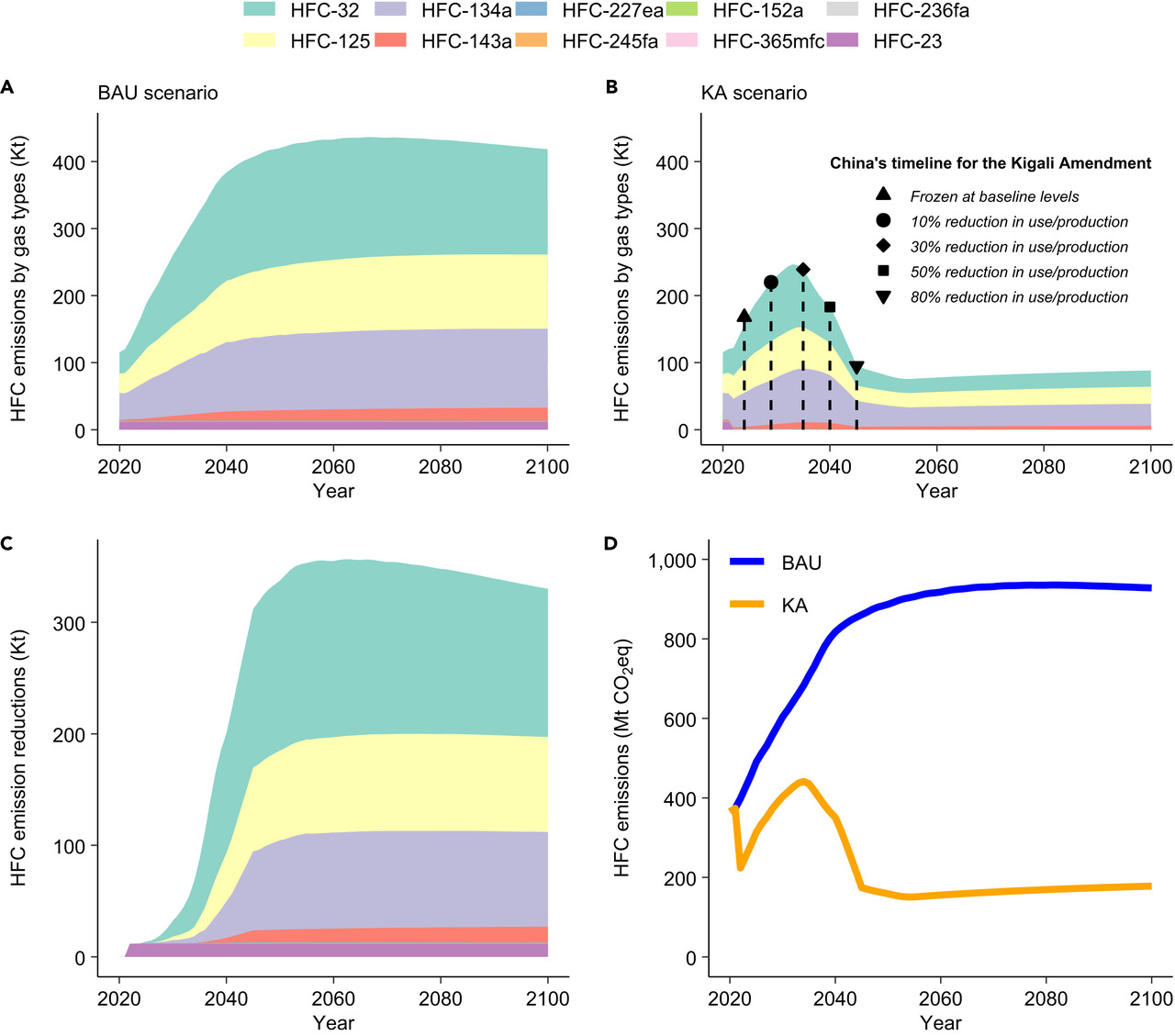
(A) HFC emissions in China under the BAU scenario by 2100.
(B) HFC emissions in China under the KA scenario by 2100.
(C) Reduction amounts of HFC emissions under the KA scenario before 2100.
(D) CO2 equivalent of HFC emissions in China under the BAU scenario and the KA scenario by 2100.
The complete study is available in open access in Cell Reports Sustainability and FRIDOC.
Source
Wu, Z., Su, X., Zhu, W., & Wang, T. (2025). Climate benefits from China’s adherence to the Kigali Amendment. Cell Reports Sustainability. https://doi.org/10.1016/j.crsus.2025.100431