
 Share
ShareRenewable and recovered energies make up 66.5% of France’s district heating networks
District networks supply heating to more than 50,000 buildings and cooling to more than 1,600 buildings, according to FEDENE’s latest annual survey, conducted under the supervision of the French Ministry of Ecological Transition.
In 2023, France had 43 cooling networks and 1,000 heating networks, according to the annual survey carried out by the French professional Federation of Energy and Environment Service Companies (FEDENE) under supervision of the country’s Ministry of Ecological Transition.
District heating networks in France
From 2022 to 2023, the number of district heating networks in France rose by 6%, with 50,065 buildings connected in 2023 compared with 47,380 in 2022. Net heat supplied by these networks amounted to 26.4 TWh in 2023, compared with 26.3 TWh in 2022.
The share of renewable and recovered energies (R&R energy) in the energy mix remains on a decarbonisation trajectory following the sharp increases in 2021 and 2022. In 2023, R&R energy accounted for 66.5% of the energy mix.
The share of fossil fuels (e.g. coal, fuel oil) had shrunk from 2.6% in 2022 to just 1%. As a reminder, this share was 13.3% in 2012.
This transition is based on two main pillars:
- Recovery of surplus heat, in particular from waste-to-energy plants and industrial sectors (accounting for 44% of the R&R energy share)
- Sustainable use of biomass produced in France (36% of the R&R energy share) as a substitute for polluting energy sources such as coal and fuel oil
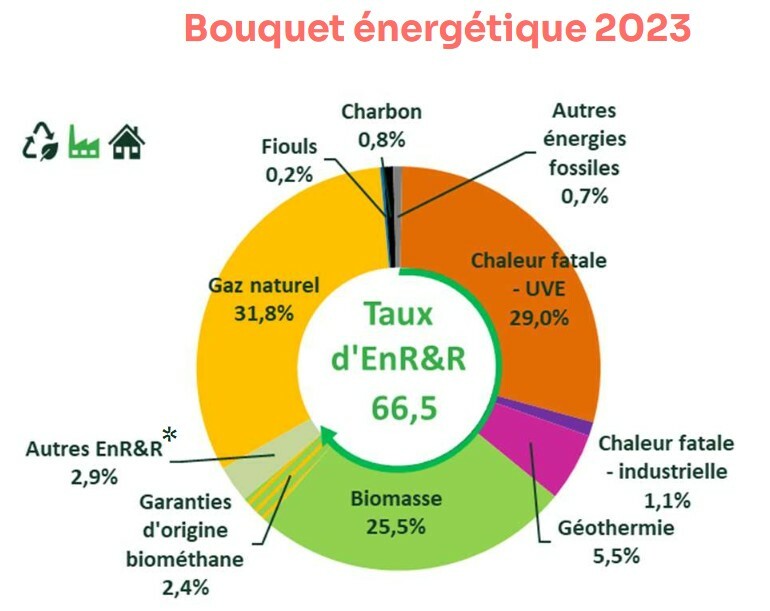
From 2013 to 2023, the number of buildings connected to heating networks rose by 85%. The energy consumption of these buildings continuously decreased, from an annual average of 848 MWh per building in 2013 to 584 MWh in 2023.
District cooling networks in France
In Europe, France is the leading country in cooling supply, slightly ahead of Sweden (see our previous article). In 2023, in France, 1,637 buildings were connected to district cooling networks, compared with 1,563 in 2022. The networks supplied 0.9 TWh of net cooling in 2023, down from 1.0 TWh in 2022. This drop can be attributed in particular to lower summer temperatures in 2023 compared to 2022.
Cold in France’s district networks is primarily generated by electric compression refrigeration systems (82%), i.e., systems which use electricity to compress refrigerants.
Among these electric compression refrigeration systems, around 12% use heat pumps capable of providing both heating and cooling, although their contribution to the overall cooling production remains low.
2030 and 2050 outlooks
In France, the Energy Transition for Green Growth Act (LTECV) calls for a significant increase in the amount of R&R cold supplied by district cooling networks.
To achieve EU commitments, an implementation tool has been developed under the LTECV, the Multi-Annual Energy Plan. Currently under review, the plan sets more ambitious targets for heating and cooling networks: 68 TWh of heat delivered by district networks in 2030, with 75% R&R heat (51 TWh), rising up to 90 TWh in 2035, with 80% R&R heat (72 TWh).
For more information, the full survey results are available on FRIDOC and on the FEDENE website.
Source
Enquête annuelle des réseaux de chaleur et de froid 2024. https://fedene.fr/ressource/enquete-annuelle-des-reseaux-de-chaleur-et-de-froid-2024/