
 Share
ShareGL2024: Improving the performance of R744-refrigeration systems at high ambient temperatures
A paper presented during the 16th IIR-Gustav Lorentzen Conference on Natural Refrigerants proposes improving the performance of R744 refrigeration systems in transcritical operation using low-charge R290 mechanical subcooling.
At high ambient temperatures (above about 27°C), R744 refrigeration systems operate in transcritical mode, resulting in a significant increase in flash gas production during throttling. This results in a decrease in R744 cooling capacity and efficiency, which in turn leads to a reduction in the coefficient of performance (COP) at high ambient temperatures.
To counteract this, mechanical subcooling can be used. It consists in using an additional refrigeration system whose evaporator is used to subcool R744 prior to throttling. During experimental studies on a laboratory scale, R1234yf and R600a have been tested as refrigerants for mechanical subcooling, resulting in an increase in the R744 cooling capacity of up to 39% and 43% respectively, and an improvement in the COP of up to 26%.
It has been suggested that propane (R290) can offer further potential to improve the COP, with the added benefit of enabling the design of a compact system with low refrigerant charge. In addition, R290 is a natural refrigerant with a low global warming potential (GWP = 3), and is therefore not affected by the restrictions of the 2024 EU F-Gas Regulation.
In a study presented during the 16th IIR-Gustav Lorentzen Conference on Natural Refrigerants, Pertiller et al. tested a R290 module with a maximum refrigerant charge of 150 g in a R290 module low-charge to comply with current standards. A commercial R744 refrigeration system with a capacity of approximately 50 kW was equipped with three charge-minimized R290 modules. The R290 subcooler modules improved the performance of the tested system in terms of operating behaviour ("steady", "unsteady") and efficiency (COPcool) at all tested operating points.
The figure below shows the change in COP when a subcooling module is switched on or off, and a similar trend in both simulation and measurement can be observed.
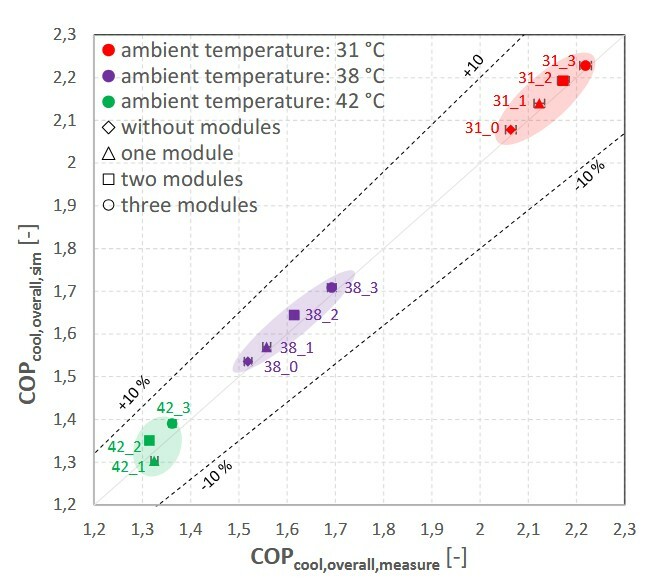
Measurements taken at an ambient temperature of 42°C demonstrate the beneficial impact of subcoolers on the performance of an R744 refrigeration system operating at its design limit. Given recent climate trends, the authors believe that some "older" R744 refrigeration systems will increasingly encounter such operating conditions in the future. Retrofitting these systems with R290 subcoolers could therefore help ensure stable operation and performance moving forward.
For more information, the complete paper is available on FRIDOC.
Source
Pertiller G., Rieberer R., Schöffl L., Kotenko A. Low charge R290-subcooler to improve the performance of R744-refrigeration systems. 16th IIR-Gustav Lorentzen Conference on Natural Refrigerants (GL2024). Proceedings. University of Maryland, College Park, Maryland, USA, August 11-14, 2024 http://dx.doi.org/10.18462/iir.gl.2024.1222