
 Share
ShareNovel anti-frosting heat pump technology
A review article published in Energies, presents advancements of heat-source tower heat pump systems (HSTHPSs) in China, including operating principle, heat-source tower (HST) structure, heat and mass transfer characteristics, HSTHPS performance, antifreeze solution use, and antifreeze solution regeneration.
Air source heat pump (ASHP) is an energy-efficient technology that allows heating at different ambient temperatures [1]. However, the operation efficiency of the ASHP is significantly reduced when the ambient temperature decreases and humidity increases. When ASHP operates for space heating, frost may form over the fin and tube surface of the outdoor heat exchanger when the surface temperature is below both 0°C and the dew point temperature of the moist air [1]. According to the IIR, anti-frosting/defrosting technologies are required to allow ASHPs to operate in different climates, from -25°C to +50°C [1].
A novel type of heat pump system, named the heat-source tower heat pump system (HSTHPS), has recently been developed in southern China, providing both heating and cooling options for buildings [2].
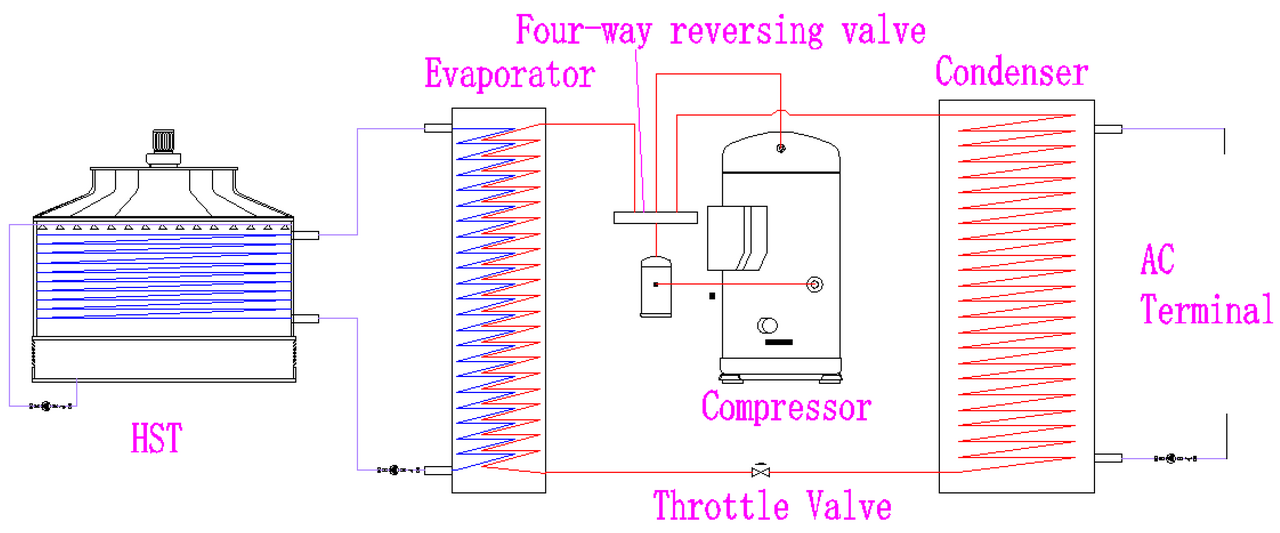
As shown in Figure 1, the HSTHPS is composed of a Heating-Source Tower (HST) and a heat pump unit (HPU). The HST is the absorption device that absorbs heat from ambient air. The structure of the HST is similar to that of a traditional cooling tower.
In winter, an antifreeze solution with a freezing point below 0°C is utilized as the HST medium to extract the low-temperature heat from the air. The medium flows into the evaporator of the HPU and releases the low-temperature heat via the reverse Carnot cycle. This feature of the HSTHPS allows the air to release not only sensible heat but also latent heat from the condensation of water vapour in the air, indicating that the HSTHPS possesses potential in humid areas.
In summer, when the HST medium is replaced by water, the HST connects with the condenser of the HPU to achieve better heat dissipation. From the perspective of a heat source, the HSTHPS is a type of ASHP. The only difference between a traditional ASHP and a HSTHPS is that the HSTHPS includes a heat transfer between the HST medium and ambient air. Depending on the HPU type, the HSTHPS is also a derivative of the water/ground-source heat pump system.
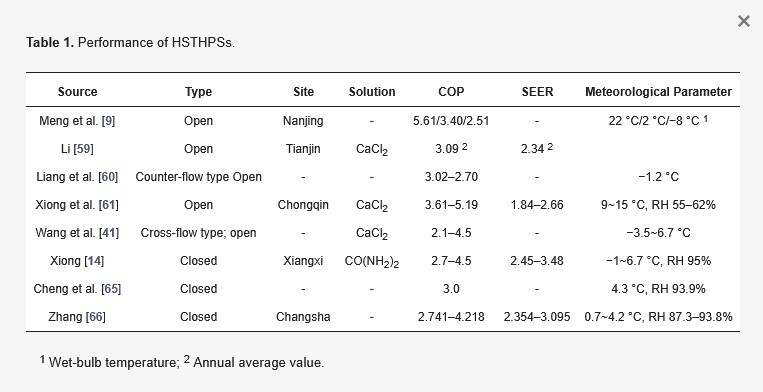
Existing studies summarised on table 1 suggest that the coefficient of performance (COP) of the HSTHP is significant, but the system energy efficiency ratio (SEER) of the HSTHPS does not show a clear advantage.
For instance, one study compared the heating performance between the HSTHPS and a typical ASHP in Tianjin, China [3]. The annual average COP of the HSTHPS was 48% higher than that of the ASHP unit, and the SEER of the HSTHPS was only 5% higher than that of the ASHPS. However, the annual power consumption of the HSTHPS was 4.9% lower than that of the ASHPS.
Moreover, the antifreeze solution has a high viscosity, which increases the power consumption of the solution circulation pump and the HSTHPS fan. Therefore, the optimal operation strategies for different conditions need to be developed through long-term experiments and theoretical exploration.
Finally, similar to a traditional ASHP, heat-source tower heat pump system (HSTHPS) should be combined with industrial waste heat recovery technologies or renewable energy such as solar energy, in order to improve the efficiency of the entire system.
For more information, the article is available in open access in Energies or in FRIDOC.
Sources
[1] Li X., Wang B. Air source heat pumps for space heating and cooling, 41st Informatory Note on Refrigeration Technologies. http://dx.doi.org/10.18462/iif.NItec41.01.2021
[2] Yao X, Feng R, Li X. A Review on the Heat-Source Tower Heat Pump Systems in China. Energies. 2024; 17(10):2389. https://doi.org/10.3390/en17102389
[3] Li, J. Analysis on Heating Applicability of Energy Tower Heat Pump System in Tianjin. Ph.D. Thesis, Tianjin University, Tianjin, China, 2015. (In Chinese).