
 Share
ShareWorld Energy Employment 2025: Skilled workers are needed to meet growing demand for energy jobs
According to IEA's 2025 World Energy Employment report, employment in the energy sector increased by 2.2% in 2024, exceeding the 1.3% average for the entire economy. With the growing employment demand in the energy sector, policy measures are required to curb the global skilled workers shortage.
In December 2025, the International Energy Agency (IEA) released its annual World Energy Employment report, presenting a detailed overview of energy employment, including estimates of the workforce's size and distribution across different regions, sectors, and technologies.
According to IEA, the global energy sector – which in this report includes energy supply, the power sector, end-use efficiency and vehicle manufacturing – employed over 76 million workers in 2024 [1]. Driven by the electricity sector, now the largest energy employer ahead of fuel supply, employment increased by 2.2%% in 2024, outpacing the economy-wide average of 1.3%, thanks to continued investment in energy infrastructure.
Estimated workforce in building sector, including heat pumps
IEA categorises as “end-use efficiency” the sectors of energy efficiency in buildings – covering retrofits, heating, ventilation and air conditioning equipment, as well as appliances – and of the efficiency of electric motors in industry. In 2023, IEA had estimated that end use efficiency, including HVAC in buildings, employed 9.8 million workers worldwide [2]. In the World Energy Employment 2025 report, the scope of the workforce is more detailed in end-use sectors, now distinguishing subsectors such as heat pumps (see table 1). China leads the heat pumps labour market with 300,000 workers, followed by Europe and North America each with an estimated 200,000 workers [1].
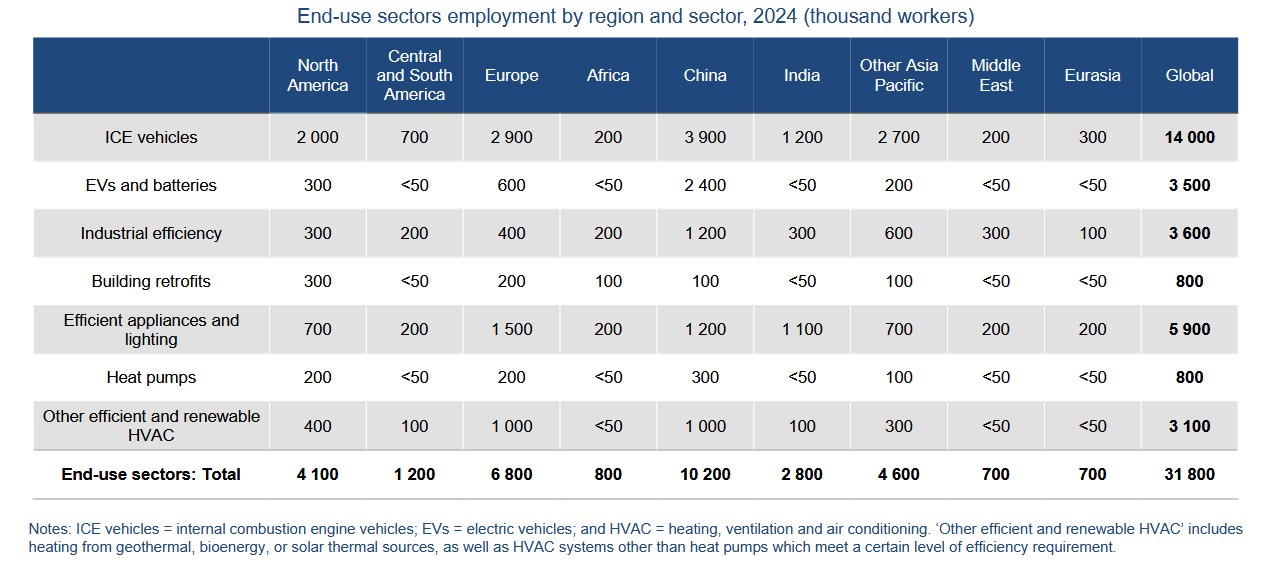
Note that these figures may not accurately reflect employment in all refrigeration applications outside of building sector.
Global employment in heat pumps grew by less than 4% in 2024, a notable decrease compared to the 6% CAGR observed between 2020 and 2023. This slowdown is related to decreasing sales caused by discontinued or scaled back government subsidies and easing natural gas prices. The slowdown has been particularly impactful in Europe where heat pump jobs have first stagnated in 2023 and then declined in 2024.
Nevertheless, early indicators suggest a turnaround in current policy settings, which could drive heat pump jobs growth at a CAGR of 4.5% between 2024 and 2035.
Challenges of the growing employment demand in the energy sector
Although the global energy workforce is expected to continue steadily growing by 2035, skilled workers shortage is a crucial concern. There is a severe imbalance between the number of qualified energy workers joining the workforce to replace retirees and meet rising demand. Economy-wide demand for applied technical workers grew 16% between 2015 and 2022, yet graduations from relevant vocational programmes increased by only 9%.
In this context, IEA points out that while investment in Artificial intelligence (AI) skills is rising in the energy sector, current use cases do not significantly reduce demand for applied technical workers in construction, operations, and maintenance, which are mostly manual roles dominated by tasks that AI is not currently well suited to replace.
Effective policy measures are needed to address skilled labour shortages, working with industry, educators, and labour representatives to develop a workforce that can meet emerging energy-system needs. According to IEA, policy measures should focus on the following:
- Encouraging early interest in technical and trade careers
- Financial incentives for trainees and for employers
- Industry engagement and work-based learning
- Changing public perceptions of technical career paths
- Curriculum and credential modernisation
- Accessible training options
- Labour market monitoring and skills mapping
- Promoting decent work to attract workers
For more information, the complete report is available on FRIDOC and on the IEA website.
Sources
[1] IEA (2025), World Energy Employment 2025, IEA, Paris https://www.iea.org/reports/world-energy-employment-2025, Licence: CC BY 4.0
[2] IEA (2024), World Energy Employment 2024, IEA, Paris https://www.iea.org/reports/world-energy-employment-2024, Licence: CC BY 4.0