
 Share
ShareWorld Energy Outlook 2025: electricity demand at the heart of global economy, driven by cooling
In the 2025 edition of its flagship report, the IEA predicts a 40% increase in peak electricity demand driven mainly by increased demand for cooling. Due to AI, electricity demand for data centres is expected to double by 2030, but only in the United States, China and the EU.
In November 2025, the International Energy Agency (IEA) released its annual World Energy Outlook report, which analyses global trends in energy demand and supply.
IEA offers an overview of the current global energy outlook using the following explorative, “business-as-usual” scenarios:
- The Current Policies Scenario (CPS) considers a snapshot of policies and regulations that are already in place and offers a generally cautious perspective on the speed at which new energy technologies can be deployed in the energy system.
- The Stated Policies Scenario (STEPS) considers the application of a broader range of policies, including those that have been formally tabled but not yet adopted as well as other official strategy documents that indicate the direction of travel. Barriers to the introduction of new technologies are lower than in the CPS, but this scenario does not assume that aspirational targets are met.
According to IEA, electricity is at the heart of advanced and emerging economies, and electricity demand is projected to grow faster than overall energy use in all modelled scenarios. Peak electricity demand is expected to grow by around 40% by 2035 in the STEPS, with similar trends in the other scenarios, largely due to increased demand for cooling. In advanced economies, electric vehicles charging and data centres drive electricity demand. In emerging market and developing economies, rising incomes boost demand for air conditioners and other appliances (a).
(a) The appliances and equipment category includes larger devices that are plugged into electricity mains, namely refrigerators, washing machines, dishwashers, dryers and televisions (appliances like air conditioners, heaters and stoves or ovens are treated seperately). https://www.iea.org/energy-system/buildings/appliances-and-equipment
Drivers of electricity demand in the business-as-usual scenarios
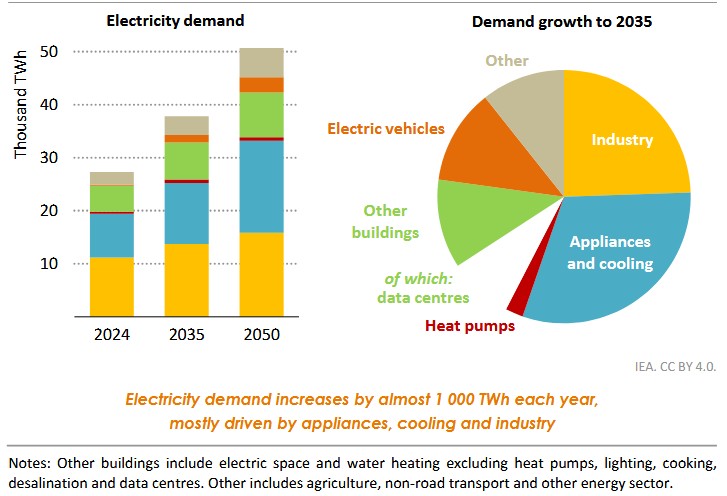
In the CPS scenario, global electricity demand is expected to increase by almost 1 000 terawatt-hours (TWh) each year to 2035, with appliances and cooling contributing 30% of the increase (see figure 1). Globally, electricity demand for space cooling climbs by almost 1 500 TWh by 2035, in a scenario where MEPS are not reinforced.
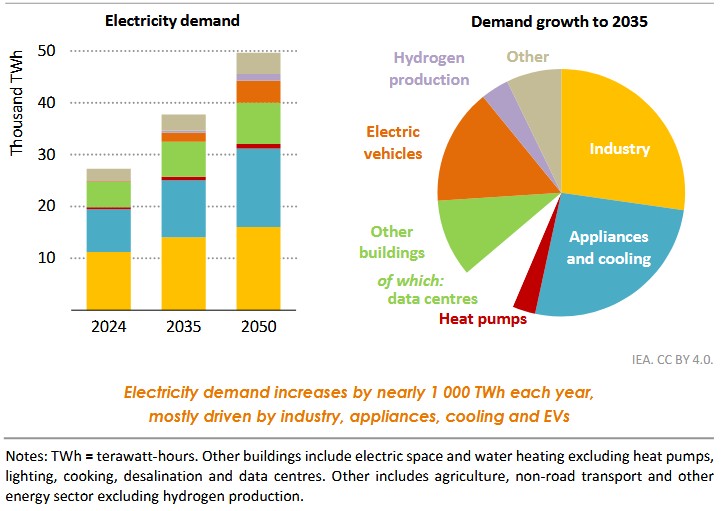
In the STEPS scenario, global electricity demand is expected to increase by almost 1 000 TWh each year to 2035, driven by industry uses contributing 30% of the increase, closely followed by appliances and cooling (see figure 2).
The rise in AI-driven servers should see a doubling in electricity demand for data centres, although limited to regions where data centres are typically located which is the United States, China and the EU. Globally, data centres and AI account for less than 10% of global growth in electricity demand.
Renewable energy and access to electricity
The 2025 report also highlights the continued growth of renewable energy, led by solar photovoltaics. In the STEPS scenario, the share of renewables in total electricity generation is expected to reach nearly 55% by 2035. According to IEA, China remains the largest market for renewables – accounting for 45-60% of global deployment over the next ten years across the scenarios – and the largest manufacturer of most renewable technologies.
It should be noted that the IEA estimates that about 730 million people still live without electricity. Unfortunately, the pace of electrification has slowed down in the aftermath of the Covid-19 pandemic and the global energy crisis. In 2024, the number of people living without electricity fell by 11 million compared with 2023, which is less than the average 65 million annual reductions seen between 2010 and 2019.
For more information, especially regional insights, the complete report is available on FRIDOC or on the IEA website.
Source
IEA (2025), World Energy Outlook 2025, IEA, Paris https://www.iea.org/reports/world-energy-outlook-2025 , Licence: CC BY 4.0 (report); CC BY NC SA 4.0 (Annex A)